
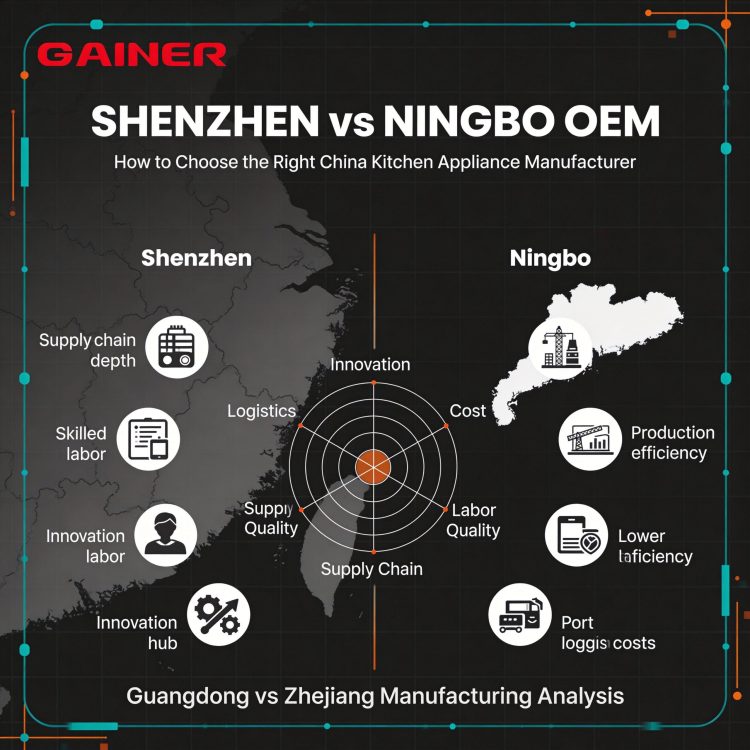
Shenzhen vs Ningbo OEM: How to Choose the Right China Kitchen Appliance Manufacturer for Your Brand
Key Takeaways:
- Guangdong Province accounts for approximately 45% of China’s appliance output, while Zhejiang (Ningbo/Cixi) contributes roughly 25%, creating two distinct sourcing ecosystems (SourcifyChina).
- Shenzhen-area factories typically offer 1,000–3,000 unit MOQs for OEM smart appliances, while Ningbo factories often start at 2,000–10,000+ units for kitchen electrics (NewBuyingAgent).
- Guangdong production costs run 15–25% higher than Zhejiang, but deliver approximately 30% fewer post-shipment defects (SourcifyChina).
- Ningbo-Zhoushan Port handled 14.32 billion tons of cargo in 2025 — the world’s busiest port for 17 consecutive years — while Shenzhen’s Yantian port offers superior connectivity to Hong Kong logistics (宁波舟山港).
Introduction
China produces over 70% of the world’s small home appliances, with an annual manufacturing capacity of approximately 23.2 billion units (BESTIM). For brand owners, importers, and Amazon sellers, this dominance creates an obvious sourcing destination — but it also creates a critical decision: which manufacturing region should you work with?
The choice between Shenzhen (Pearl River Delta) and Ningbo (Yangtze River Delta) is not about which region is better. It is about which region matches your product type, brand positioning, and market strategy. At Shenzhen Gainer Appliances, we have spent 13 years operating as an OEM/ODM kitchen appliance manufacturer in the Pearl River Delta, with 6 production lines, a 9,000 m² facility, 300 employees, and a monthly capacity of 250,000 units. This article draws on that experience to help B2B buyers understand the regional differences that shape every sourcing decision.
The global kitchen appliance market is growing at 6–8% annually, projected to reach nearly $380 billion by 2033 (YLD Home). Understanding where and how to source from China is not a tactical detail — it is a strategic advantage.
The Two Ecosystems: PRD vs YRD Manufacturing Clusters
Supply Chain Density and Industrial Clustering
The Pearl River Delta (PRD), anchored by Shenzhen, Dongguan, Foshan, and Zhongshan, operates as a high-speed, vertically integrated manufacturing corridor. In this region, a factory can source all required components — plastic molds, PCBs, heating elements, and packaging — within a 24-hour radius. The speed translates directly to market: 7-day sample production and 15-day delivery are common benchmarks in the PRD (CSDN).
The Yangtze River Delta (YRD), centered on Ningbo, Cixi, and Hangzhou, operates at a different scale. Cixi alone — a city under Ningbo’s jurisdiction — houses over 2,000 complete product enterprises and more than 10,000 supporting enterprises, covering over 20 product categories and a thousand product varieties. Within a one-hour economic circle, manufacturers can procure 90% or more of their materials (新华社). In 2025, the Cixi smart home appliance industry cluster generated 108.38 billion yuan in revenue, with 523 above-scale enterprises (新华社).
The practical difference for a B2B buyer: the PRD offers speed and agility — ideal for consumer electronics-adjacent products requiring rapid iteration. The YRD offers scale and depth — ideal for high-volume kitchen electrics where the supply chain maturity of a dedicated appliance cluster reduces per-unit cost.
Factory Type Differences: Technology-Driven ODM vs Scale OEM
The two regions have evolved distinct factory profiles. Shenzhen-area factories, shaped by the consumer electronics ecosystem, tend to be technology-oriented ODM manufacturers — they invest in in-house R&D, industrial design, PCB engineering, and firmware development. This makes them natural partners for brands that need differentiated products with custom functionality, not just a logo on a standard model.
Ningbo/Cixi factories, by contrast, are the world’s scale OEM engine for kitchen electrics. Most of the world’s mid-market electric kettles, coffee makers, blenders, toasters, and air fryers come from Ningbo factories. They supply major Western brands including KitchenAid, Cuisinart, Hamilton Beach, Black & Decker, and Breville (NewBuyingAgent). The infrastructure exists for sophisticated product development, regulatory compliance, and large-volume production — but the model is built around proven platforms at scale, not custom engineering from scratch.
This does not mean Ningbo factories lack R&D capability. Cixi manufacturers can develop a new heater model from design to market in less than two months (中国经济网). But the R&D model is typically platform-based iteration — adapting existing architectures to new specifications — rather than the ground-up custom development more common in Shenzhen.
| Dimension | Shenzhen / PRD | Ningbo / YRD |
|———–|—————|————–|
| Dominant factory model | Technology-oriented ODM | Scale OEM with platform ODM |
| Typical R&D approach | Custom engineering, ground-up design | Platform-based iteration, rapid adaptation |
| Supply chain characteristic | 24-hour component radius, agile | 1-hour material radius, deep cluster |
| Lead time (standard OEM) | 30–45 days (SourcifyChina) | 35–50 days (SourcifyChina) |
| Above-scale enterprise density | High (electronics + appliances) | Very high (appliance-specialized) |
Cost Structure: Where Your Margin Lives
Labor Costs
Factory worker wages in Shenzhen average approximately ¥66,426 per year (roughly ¥5,535/month), with an hourly rate of about ¥29.48 (SalaryExpert). In Cixi (Ningbo area), assembly line workers in small appliance factories earn approximately ¥5,000–7,000/month, with hourly rates of ¥16–22 (鱼泡网). The labor cost differential between the two regions is roughly 15–25%.
However, labor cost is only one piece of the equation. The PRD’s higher labor cost correlates with a more experienced, electronics-skilled workforce — a meaningful factor when producing appliances with smart features, digital controls, or complex PCB integration.
The Margin Reality
The small appliance OEM industry operates on thin margins. According to research by the Zhejiang Academy of Social Sciences, pure OEM manufacturing without in-house design yields gross margins of no more than 15%, with some falling below 10%. ODM work with in-house R&D achieves approximately 20% margins, while mature branded products can reach 40% or higher (新华社).
This margin structure explains why over 70% of Cixi’s appliance output remains OEM-dependent, and fewer than 20% of the 2,000+ complete product enterprises operate stable independent brands (新华社). For B2B buyers, this means the factory’s capabilities — not just its price — determine the value you receive. A factory with strong ODM capabilities can deliver a product that commands higher retail margins, offsetting a higher unit cost.
Total Cost Comparison
| Cost Element | Shenzhen / PRD | Ningbo / YRD |
|————-|—————|————–|
| Labor (monthly/worker) | ~¥5,500–6,600 | ~¥5,000–7,000 |
| Overall production premium | 15–25% higher (SourcifyChina) | Baseline |
| Post-shipment defect rate | Lower (~30% fewer defects) (SourcifyChina) | Higher (mid-tier) |
| FOB electric kettle (1.7L) | $6–15 (China-Electronics) | $6–15 (comparable range) |
| FOB blender (personal) | $10–22 (China-Electronics) | $10–22 (comparable range) |
Minimum Order Quantity: The Real Numbers
MOQ is the most common source of buyer frustration in China sourcing — and the numbers differ meaningfully between regions.
For Ningbo kitchen electrics, Tier-1 factories serving major brands typically require 10,000+ units. Mid-market factories serving growing brands and retailer private labels operate at 2,000–5,000 units. Stock products with light customization can start at 10–500 units (NewBuyingAgent).
For Shenzhen smart appliances (kettles, fans, small kitchen devices), Bao’an district OEM factories typically quote 1,000–3,000 units, while Huaqiangbei stock-equivalent products can go as low as 100–500 units (NewBuyingAgent).
For private label kitchen appliances across both regions, standard MOQs start at 500–1,000 units, with trial orders of 50–100 units typically possible at a 20–50% cost premium over bulk pricing (YLD Home).
At Shenzhen Gainer Appliances, we accommodate both ends of the spectrum — supporting small-batch trial orders for market validation while maintaining 250,000-unit monthly capacity for scaled production.
Certification and Compliance: The Non-Negotiable Foundation
For B2B buyers entering the US or EU markets, certification is not a nice-to-have — it is the barrier to entry. The two regions approach compliance differently.
Guangdong Province leads in certification readiness: over 90% of factories in the region hold CE and UL certifications, offering the lowest compliance risk for EU and North American markets (SourcifyChina). This reflects the PRD’s export orientation toward regulated Western markets.
Zhejiang factories maintain strong certification coverage but with more variability across tiers. Top-tier Ningbo factories serving global brands hold comprehensive certifications; mid-tier factories may have gaps that buyers need to verify.
The key certifications and their typical costs:
| Certification | Market | Typical Cost | Timeline |
|————–|——–|————-|———-|
| UL/ETL | USA | $3,000–8,000/SKU (China-Electronics) | 4–6 months |
| CE (LVD+EMC) | EU | ¥8,000–25,000 (煜通天下) | 3–5 weeks |
| FCC | USA | ¥10,000–40,000 (煜通天下) | 3–6 weeks |
| UKCA | UK | ¥8,000–25,000 | 3–5 weeks |
| RoHS | EU | ¥1,500–5,000/material (煜通天下) | 5–10 working days |
Shenzhen Gainer Appliances holds 9 core certifications (ISO 9001, CE, CB, GS, RoHS, LFGB, ETL, REACH, BSCI), plus FDA/SAA where market requires — a reflection of the PRD’s compliance-first manufacturing culture.
R&D Speed: How Fast Can You Go from Concept to Container?
Speed to market separates winners from followers in the Amazon and DTC space. Here, the two regions reveal different strengths.
The PRD model excels at custom-ground-up development. The region’s consumer electronics DNA means factories are comfortable with PCB design, firmware programming, and industrial design iteration. A full ODM development cycle — from concept to mass production — typically takes 45–60 days (Youbenlife). For complex OEM projects requiring new tooling, expect 12–16 weeks (SourcifyChina).
The YRD model excels at platform-based rapid adaptation. Cixi factories can take an existing heating appliance platform, modify the design, tooling, and controls, and have a new product ready for market in under two months (中国经济网). This is ideal for brands that need a product variant — a different size, feature set, or aesthetic — rather than a novel product architecture.
The choice for buyers: if you need a unique product with custom engineering, the PRD’s deeper R&D infrastructure is the stronger fit. If you need a proven product category with modifications, the YRD’s platform speed is hard to beat.
Export Market Focus: Where Your Products Are Headed
The two regions have developed different export market orientations, shaped by logistics, historical trade relationships, and factory capabilities.
Shenzhen/PRD factories are strongly oriented toward North American and Western European markets. The region’s compliance infrastructure (UL, FCC, CE readiness), its higher quality consistency, and its proximity to Hong Kong’s logistics hub make it the natural choice for brands targeting regulated, quality-sensitive markets. Guangdong factories serving global brands deliver premium-tier quality with strict QC protocols (SourcifyChina).
Ningbo/YRD factories serve a broader export mix. Cixi exported 3.32 billion yuan in heating appliances alone in the first 11 months of 2025, with 1.28 billion yuan to the EU (up 8.4% year-on-year) and substantial volumes to the Middle East, Russia/Central Asia, Southeast Asia, and Latin America (中国经济网). The broader market reach reflects the YRD’s strength in producing cost-competitive products that meet diverse regional standards.
The 2026 export landscape shapes up as follows, according to industry research (BESTIM):
| Target Market | Market Profile | Better Regional Fit |
|————–|—————|———————|
| North America | Recovering demand, strict compliance (UL/FCC), premium positioning | Shenzhen / PRD |
| Western Europe | High energy-efficiency standards, strong regulatory requirements | Both (PRD for premium, YRD for volume) |
| Middle East | High-margin, quality-sensitive, outdoor/commercial appliances | Both (YRD strong in heating) |
| Southeast Asia | Volume-driven, price-sensitive, basic functionality | Ningbo / YRD |
| Russia/Central Asia | Policy-driven demand, heating/seasonal products | Ningbo / YRD |
Ports and Logistics: Getting Your Products to Market
Ningbo-Zhoushan Port is the world’s largest port by cargo throughput — 14.32 billion tons in 2025, marking 17 consecutive years as global #1. Container throughput reached 43.87 million TEU, ranking third globally. The port ranked #6 worldwide in the 2026 Xinhua-Baltic International Shipping Center Development Index (宁波舟山港). Transit times: 18–22 days to US West Coast, 28–32 days to East Coast (NewBuyingAgent).
Shenzhen Port (Yantian) offers superior connectivity to Hong Kong’s international logistics infrastructure, with frequent vessel service to all major global ports. For buyers who need to combine factory visits with Hong Kong travel, or who value the financial and legal infrastructure Hong Kong provides, Shenzhen’s proximity is a tangible advantage.
How to Choose: A Decision Framework for B2B Buyers
After 13 years of manufacturing kitchen appliances in Shenzhen, here is the framework we recommend to our clients:
Choose a Shenzhen/PRD factory when:
- Your product requires custom engineering, PCB design, or smart/IoT features
- You are targeting North America or Western Europe with strict compliance requirements
- You need lower MOQs (1,000–3,000 units) for market testing
- Quality consistency is your primary concern over unit cost
- You value a factory partner that can act as a co-development engine, not just a production line
Choose a Ningbo/YRD factory when:
- Your product is a standard kitchen electric (kettle, toaster, blender, air fryer) in a proven category
- You are ordering at scale (5,000+ units) and cost optimization is critical
- Your target markets include Middle East, Southeast Asia, or CIS countries
- You need rapid platform-based iteration of existing designs
- You benefit from the deepest appliance-specific supply chain cluster in the world
Frequently Asked Questions
Q: What is the typical MOQ for a custom kitchen appliance from Shenzhen?
A: For OEM kitchen appliances from Shenzhen factories, typical MOQs range from 1,000–3,000 units for smart appliances. Trial orders of 50–100 units are often possible at a 20–50% premium over bulk pricing. At Shenzhen Gainer Appliances, we offer flexible MOQ structures to accommodate both market validation and scaled production.
Q: How much does UL certification cost for a small kitchen appliance?
A: UL certification for a small kitchen appliance typically costs $3,000–$8,000 per SKU and takes 4–6 months to complete (China-Electronics). ETL certification (Intertek) is accepted by essentially all retailers that accept UL and often has a faster turnaround.
Q: Which region is better for Amazon FBA sellers launching a private label brand?
A: For Amazon FBA sellers, the choice depends on your product category. Shenzhen/PRD factories are better suited for differentiated, feature-rich products where quality consistency protects your review rating. Ningbo/YRD factories are better for high-volume, price-competitive kitchen electrics where the established supply chain keeps landed costs low. Many successful Amazon sellers split their sourcing — using PRD factories for hero SKUs and YRD factories for volume catalog items.
Q: What are the real labor cost differences between Shenzhen and Ningbo?
A: Shenzhen factory workers earn approximately ¥66,426/year (roughly ¥5,535/month) (SalaryExpert), while Ningbo/Cixi workers earn approximately ¥5,000–7,000/month. The overall production cost premium for Guangdong is approximately 15–25% over Zhejiang, but this is offset by roughly 30% fewer post-shipment defects (SourcifyChina).
Q: How long does it take to develop a new kitchen appliance from concept to shipment?
A: A full ODM development cycle — from industrial design to mass production — typically takes 45–60 days (Youbenlife). For OEM projects requiring new tooling, expect 12–16 weeks. Sea freight adds 18–35 days depending on destination port. The total timeline from first contact to landed goods is approximately 3–6 months for a new product.
Conclusion
China’s small appliance manufacturing ecosystem is not a single market — it is two distinct ecosystems, each with its own strengths, cost structures, and ideal buyer profiles. The Shenzhen/PRD cluster offers technology-driven ODM, lower MOQs, stronger compliance infrastructure, and premium quality consistency — at a 15–25% cost premium. The Ningbo/YRD cluster offers unmatched scale, the world’s deepest appliance supply chain, platform-based rapid iteration, and access to the world’s busiest port — with a cost advantage that matters at volume.
The right choice is not about which region is superior. It is about which region matches your brand’s product strategy, target market, and growth stage. At Shenzhen Gainer Appliances, with 13 years of OEM/ODM experience, 9 core certifications, 6 production lines, and a 9,000 m² facility producing 250,000 units monthly, we help brands navigate this choice — whether that means manufacturing in Shenzhen or connecting you with the right partner in the right cluster.
This article was written by the Shenzhen Gainer Appliances team. For specific sourcing inquiries, contact our B2B sales team directly.
Related Engineering Resources
- 9 core certifications Your Kitchen Appliance Factory Should Have Before You Place an Order — 13 essential certifications your kitchen appliance factory needs before you order
- Food Contact Material Compliance for Kitchen Appliances: LFGB, GB 4806 Explained from the Factory Floor — LFGB, GB 4806 food contact material compliance explained from the factory