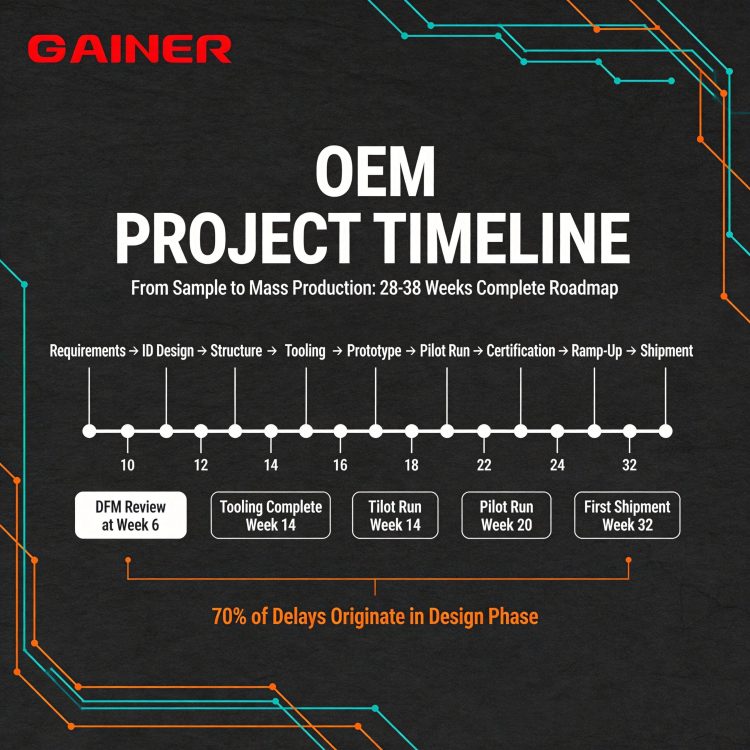
From a napkin sketch to a container load of finished products, a complete OEM project for a medium-complexity kitchen appliance takes 28-38 weeks (7-9.5 months). Simple products can compress to 18-24 weeks; complex products with electronics, multi-component assembly, and precision tooling can extend to 40-52 weeks (10-13 months). The single largest time consumer is mold development, accounting for 30-40% of the total cycle. But the most counterintuitive finding is that 70-80% of delays don’t originate on the factory floor—they trace back to the design phase. Incomplete specifications, skipped DFM reviews, and design changes after mold steel is cut all cascade downstream with the “1-10-100” rule of cost and time amplification. This article breaks down the nine-stage OEM timeline, identifies where delays actually happen, and provides actionable strategies for compressing the schedule without sacrificing quality.
The Nine-Stage Timeline at a Glance
| Stage | Simple (Weeks) | Medium (Weeks) | Complex (Weeks) | Key Deliverables |
|---|---|---|---|---|
| 1. Requirements | 1-2 | 2-3 | 3-4 | Product requirement specification, design brief |
| 2. Industrial Design | 2-3 | 3-5 | 5-8 | 3D renderings, CMF scheme |
| 3. Structural Design | 2-3 | 3-5 | 5-8 | Structural BOM, 3D engineering drawings, DFM report |
| 4. Mold Development | 4-5 | 6-8 | 8-12 | Production molds, T1/T2 samples, dimensional reports |
| 5. Engineering Samples | 1-2 | 2-3 | 3-4 | Functional samples, test reports, assembly records |
| 6. Pilot Production | 1-2 | 2-4 | 4-6 | Pilot report, yield data, SOP documents |
| 7. Certification | 4-6 | 6-8 | 8-12 | CE/FCC/UL certificates, test reports |
| 8. Ramp-Up | 2-3 | 4-6 | 6-8 | Mass production release, capacity report |
| 9. First Shipment | 1-2 | 2-3 | 3-4 | Packing list, B/L, COO, PSI report |
| Total (excl. shipping) | 18-28 | 28-45 | 45-66 |
Note: Stage 7 (certification) can and should run in parallel with stages 4-6 and is therefore not counted in cumulative time. Sea freight adds 2-6 weeks depending on destination.
Stage 1-3: Where Delays Are Born
The requirements phase is the constitutional moment of the project—it defines the boundaries for all subsequent decisions. The single most common delay is not slow factory response but unclear buyer requirements. Many overseas buyers arrive with only a vague description like “similar to Brand X, Model Y,” triggering multiple rounds of clarification that add 3-5 days each, cumulatively reaching 2-3 weeks. A detailed written design brief—covering product definition, target market, user profile, core functions, performance metrics, target FOB cost, annual volume, launch timeline, certification requirements, and CMF direction—submitted before the project formally kicks off, reduces front-end communication time by 2-3 weeks on average. For complex products, a rough functional prototype (even a 3D-printed one) communicates requirements more effectively than any text description.
Industrial design is where aesthetic vision meets manufacturing reality. The critical risk is that design teams, unfamiliar with production processes, create forms that cannot be manufactured—undercuts that prevent mold release, wall thicknesses too thin for structural integrity, parting lines that create visible seams on premium surfaces. The solution is concurrent engineering: bring structural engineers and mold makers into the ID review process from the beginning. Well-designed parting surfaces alone can save at least 3 rounds of mold modification, saving 10+ days and significant cost. Industry data shows that this “design-for-manufacturing” collaboration can reduce mold rework by 60% and shorten the development cycle by 30% compared to the sequential “design first, ask questions later” approach.
Structural design is the bridge between “looks good” and “works reliably.” The DFM (Design for Manufacturability) review is the single most important deliverable at this stage—and the single most common one to be skipped or treated as a formality. A proper DFM review takes only 1-3 days, but skipping it adds 2-3 rounds of trial mold modifications, each adding 1-3 weeks to the schedule. The DFM checklist should cover: wall thickness uniformity (thickness variations cause shrinkage and warpage), draft angles (insufficient angles cause ejection difficulties), gate positions (poor placement creates visible weld lines on cosmetic surfaces), ejector pin layout (poor layout causes ejector marks or deformation), and cooling channel design (uneven cooling causes warpage). A buyer who assigns one engineer as the DFM decision-maker, with a 48-hour review commitment, moves 5-7 days faster than committee-based approval processes.
Stage 4: Mold Development—The Critical Path
Mold development is the longest, most expensive, and highest-risk phase. A single injection mold typically costs 50,000-300,000 RMB with a cycle of 6-12 weeks. Chinese mold shops hold a significant efficiency advantage: 31-43 days from design to T1 samples, versus 60-90 days for Western counterparts. This advantage comes from vertically integrated supply chains (steel procurement, CNC machining, EDM, polishing, assembly all in-house), multi-shift operations, and the density of mold-making talent in the Shenzhen-Dongguan industrial corridor.
The sub-stage breakdown for a medium-complexity mold: mold design (3-5 days), steel procurement and rough machining (5-7 days), CNC/EDM precision machining (8-12 days), grinding and polishing (2-3 days), assembly and debugging (3-4 days), and T1 trial with modifications (3-5 days)—totaling 24-36 days. But approximately 60% of molds need at least one modification round, adding 3-5 working days per round. The most effective time-compression strategy is parallel procurement: order steel on the same day mold design starts, since rough stock dimensions for standard grades like P20 or 718H can be determined before final CAD approval. Waiting for design sign-off before ordering steel adds 5-10 days of unnecessary delay.
Five common mold delay factors: incomplete design readiness (DFM not finalized before steel cutting), steel supply delays (special grades like S136 or NAK80 may need 3-5 extra days, and some specialty steels require import), side-action complexity (each side slider adds 5-7 days, each lifter adds 3-5 days, threaded core mechanisms add 7-10 days), slow client approval of T1 samples, and Chinese holiday periods (Spring Festival in January-February can add 2-4 weeks, Labor Day in May and National Day in October also cause capacity reductions).
Stage 5-6: Engineering Samples and Pilot Production
Engineering samples represent the first time the product exists in near-production form, using production-grade materials and built on or near the actual production line. The goal is to verify manufacturability, not just aesthetics. The most common delay here is material shortage—a single long-lead component (custom connector, specialty spring, specific IC) delays the entire sample build. In 2026, top-tier semiconductor lead times have reached 40 weeks, up 67% month-over-month in March. For products with electronic components, every critical IC should have at least two pre-qualified alternative sources identified during the structural design phase, not discovered during the sample build.
The pilot production run is the stage most commonly skipped—and most dangerously so. The purpose is not to “make products” but to verify that the production line can consistently produce at target quality, cost, and cycle time with standard operators using standard processes. The scale ladder is deliberate: engineering samples (5-10 units, process feasibility), pre-production samples (20-50 units, complete process validation), pre-production run (100-500 units, yield and cycle time baseline), pilot (500-2,000 units, operator training and tooling verification). First-pass yield in the initial pilot batch is typically just 65-75%. It takes 4-8 weeks and approximately 50,000 cumulative units of output to reach 95%+ steady-state yield. Improvement drivers, ranked by impact: mold refinement (+2-8%, 4-8 weeks), tooling optimization (+3-7%, 2-3 weeks), design changes (+5-15%, but 6-12 weeks to implement), operator proficiency (+2-5% per shift, 1 week), process parameter tuning (+2-4%, 1-2 weeks), and component consistency improvement (+1-3%, 2-4 weeks). Buyers who skip pilot production and go directly to mass production face the very real risk of sub-60% yield in full production—a disaster that can erase the entire order margin.
Stage 7-9: Certification, Ramp-Up, and Shipment
Third-party certification is the only stage that can fully overlap with manufacturing—and the most commonly mismanaged. The key insight: start certification during mold development, not after sample approval. A German brand case study with OEM Mesky demonstrated this precisely—GS certification (6-8 weeks) was launched in week 3 of mold development, running parallel to tooling, and the GS certificate was obtained in week 10 when molds were completed, saving approximately 6 weeks of total project time. The same principle applies to CE (4-6 weeks, $3,000-8,000), FCC (2-4 weeks, $1,500-5,000), UL (6-10 weeks, $5,000-15,000), and RoHS (2-3 weeks, $500-2,000). Using pre-certified wireless modules can reduce testing costs by 40-60% and compress certification to 2-4 weeks.
Production ramp-up is the transition from “can produce” to “produces stably.” The most common failure is the pilot-to-production environment mismatch: in shared production lines, the pilot run is fine-tuned by process engineers with manual parameter adjustments, but once transferred to production operators with standardized settings, yield drops significantly. Dedicated pilot production capability reduces NPI cycle time to 4-6 weeks, compared to 8-14 weeks in shared-line environments. The ramp-up gate criteria should include: first-pass yield ≥90%, all critical dimension Cpk ≥1.33, SOPs completed and verified, operators trained and certified, and test fixtures validated. Any two consecutive weeks with capacity achievement below 90% should trigger a “ramp-up alert” requiring factory management intervention.
First shipment is the factory’s finish line but not the risk’s end. Logistics chain bottlenecks—peak season August-November, incomplete customs documentation, wooden packaging without fumigation certificates—are the most common final-stage delays. Pre-shipment inspection (PSI) should be completed at least 2 weeks before the scheduled shipment date, and all shipping documents (commercial invoice, packing list, bill of lading, certificate of origin, compliance certificates) should be sent to the buyer’s nominated customs broker 5-7 days before vessel departure. For first-time buyers, the contract should specify tail payment timing (within 3 business days of inspection approval) with late payment penalties.
Time Compression Strategies That Work
- Concurrent engineering: Steel procurement starts with mold design; certification starts with mold development. This combination alone can save 6-8 weeks of total project time.
- DFM as a gate, not a formality: 1-3 days of rigorous DFM review prevents 3-5 weeks of downstream mold rework. This is the single highest-ROI time investment in any OEM project.
- Design freeze discipline: After mold steel is cut, treat every design change as a formal Engineering Change Order (ECO) with documented time and cost impact. Even a seemingly minor change like adding a snap-fit feature can require re-machining cavity sections, adding 3-5 days.
- Contractual leverage: Liquidated damages clauses (0.5-1% of order value per day, capped at 5-10%) in the purchase contract. Professional Chinese factories accept reasonable LD clauses; factories that refuse are often signaling delivery confidence issues.
- Milestone verification: Require photo or video proof at each key milestone—raw material procurement (day 3-5), production start (day 7-10), 50% completion (day 15-18), production complete (day 25-28), packaging ready (day 30).
- Long-lead item pre-planning: Identify and order all components with lead times exceeding 4 weeks during the structural design phase, not the engineering sample phase. In 2026’s semiconductor environment, single-source dependency is the largest hidden risk in any OEM timeline.
The “1-10-100” rule applies to OEM timelines as much as to quality costs: a design-phase oversight that costs 1 unit to fix will cost 10 units in manufacturing and 100 units if it reaches the customer. The same exponential relationship applies to time. McKinsey research indicates that a 6-month delay in new product launch reduces cumulative 5-year profits by approximately 33%. The most valuable 3 days in any OEM project are the DFM review days—they prevent the 3-week delays that cascade through the entire project schedule. The factories that institutionalize DFM, enforce design freeze discipline, and parallelize certification with tooling are the ones that consistently deliver on time—and those are the factories worth building a supply chain around.