
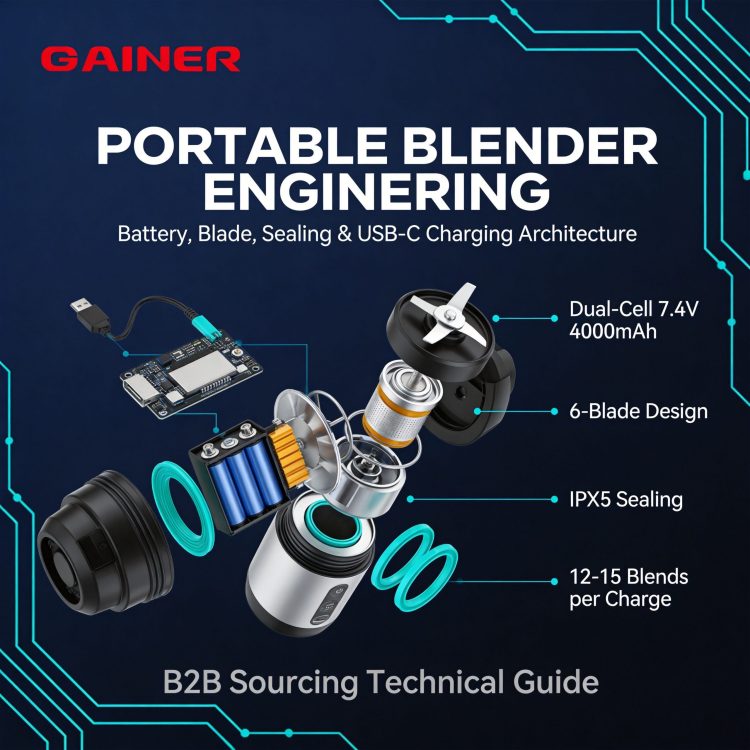
**Key Takeaways:**
– The **motor design decision** — high-torque low-speed vs. high-speed — determines whether your chopper handles hard nuts or soft herbs, defining your product’s market positioning as “power-focused” or “versatile.”
– **Tritan™ copolyester** outperforms both polycarbonate (PC) and AS resin on toughness, chemical resistance, and BPA-free safety, but costs **30–50% more** per unit — making it a premium-segment material requiring a clear ROI story for end customers.
– A **safety interlock system** based on microswitch lid detection is a regulatory requirement under **EN 12852** and the single most common point of compliance failure in third-party lab testing.
– **Battery runtime** is not a fixed number — it is a function of cell grade (2000mAh vs. 3000mAh), discharge rate, and motor load; specifying the right combination requires engineering trade-off conversations that **Shenzhen Gainer** has navigated for over **13 years** across **300+ OEM projects**.
—
## Introduction
When a brand owner or Amazon seller evaluates a **cordless chopper OEM** or **food chopper manufacturer**, the conversation often starts with unit price and MOQ. But the decisions that determine whether a product succeeds — or generates a wave of returns — are made at the engineering level.
At **Shenzhen Gainer Electrical Appliances Co., Ltd.**, a **cordless food chopper factory** established in **2013** with **6 production lines, 9,000㎡ of manufacturing space, 300 employees**, and a monthly output of **250,000 units** [(szgainer.com)](https://szgainer.com/about/), we have seen the same pattern across hundreds of OEM/ODM partnerships: brands that invest one hour understanding the engineering variables before placing an order consistently outperform those that treat the product as a commodity.
—
## 1. Motor Design: High-Torque vs. High-Speed
The motor is the single most expensive component and the primary determinant of how the product “feels” to the end user.
### High-Torque, Low-Speed Architecture
A motor configured for high torque at low RPM — typically **1,500–2,500 RPM** under load — uses a higher torque constant (kt) in its winding design. As Portescap explains, “the higher the kt, the higher the output torque at a given current” [(Portescap)](https://www.portescap.com/en/newsroom/whitepapers/2022/02/eliminate-design-compromises-in-industrial-power-tools). This design excels at processing dense ingredients: nuts, frozen fruits, hard cheeses, and raw meat. In BLDC configurations, rare-earth neodymium permanent magnets further amplify torque density without additional input power [(Jkongmotor)](https://www.jkongmotor.com/how-does-the-bldc-motor-achieve-high-torque.html).
### High-Speed Architecture
A motor optimized for speed — **2,500–4,000 RPM** under load — uses a lower kt winding. The KitchenAid Go Cordless Food Chopper operates at **2,380–4,025 RPM** across two speed settings with a 12V DC motor [(KitchenAid)](https://cdn.pdf-s.com/wp-content/uploads/2025/10/afd/kitchenaid-5kfcr531bm-electric-food-chopper-1-18-l-black-leaflet.pdf). This delivers rapid chopping for soft to medium-hard ingredients and creates a satisfying “fast” user experience. The limitation: it struggles with the hardest ingredients, and blade stall under heavy load is a risk if current protection is not calibrated correctly.
**Gainer’s recommendation**: For Amazon’s mid-to-premium tier, specify a **dual-speed BLDC motor with pulse function**. The incremental BOM cost is approximately **$2.80–$4.50 per unit**, but the feature differentiation justifies a **15–25% higher retail price** based on client market data.
—
## 2. Blade Design: S-Blade, Cross Blade, and Material Choice
### S-Blade Configuration
The S-shaped blade, machined from **420J2 or 304-grade stainless steel** with hardness of **56–60 HRC**, is the industry workhorse [(BLMEAS)](https://www.blmeas.com/news/is-a-food-chopper-the-same-as-a-food-processor.html). Its dual curved edges alternate between clockwise and counterclockwise rotation, creating a chopping-and-blending motion for uniform results [(Alibaba Hjar)](https://www.alibaba.com/showroom/hjar-china-420-steel-food-mixer-blade.html).
### Cross Blade (4-Prong)
The four-prong cross blade excels at shredding and tearing — cooked chicken, scrambled egg mix, soft cheeses — but is less effective for fine chopping of hard vegetables. It is most commonly specified for **baby food processors** and meal-prep choppers.
### 420 vs. 304 Stainless Steel
**420** is martensitic and heat-treatable for edge retention. **304** is austenitic, with **18% chromium and 8% nickel** for superior corrosion resistance, but cannot be quench-hardened [(Tiscoco)](https://www.tiscoco.com/420-vs-304-stainless-steel-hardness-corrosion-buying-guide/). At Gainer, we use 420J2 for the blade body and 304 for the shaft and hub — combining edge retention with corrosion resistance where each matters most.
### Detachable Blade Assembly
A detachable blade assembly adds approximately **$0.60–$1.20 per unit** in tooling cost but eliminates the most common consumer complaint: difficulty cleaning around the blade base. For Amazon sellers, where reviews are disproportionately influenced by cleaning experience, the detachable design is strongly recommended.
—
## 3. Cup Materials: Tritan vs. AS vs. PC — A Safety-Liability Matrix
The bowl material is a **regulatory compliance decision** with direct market-access implications.
### Tritan™ Copolyester (Eastman)
Tritan is **BPA-free, BPS-free, and free of all bisphenol compounds**, certified by the **FDA, EFSA, Health Canada, NSF International (NSF 51)**, and China’s Ministry of Health [(Eastman)](https://www.tritansafe.com/). It delivers a **Notched Izod impact strength of 860 J/m** [(ChillTitan)](https://www.chilltitan.com/tritan-vs-polycarbonate/) and survives **125+ dishwasher cycles** without cracking — while polycarbonate shatters within 30 cycles [(Eastman)](https://www.tritanmoldit.com/sites/default/files/Durables/Presentations/Durable_and_Consumer_Goods_TIC.pdf). The FDA has approved Tritan for repeated-use food contact at temperatures up to **100°C** [(Hong Kong CFS)](https://www.cfs.gov.hk/english/programme/programme_rafs/programme_rafs_fcm_01_04_Baby_Bottles_Tableware.html). Cost premium: **30–50%** over PC.
### Polycarbonate (PC)
PC offers high impact strength and a glass transition temperature near **145°C**, but its core monomer is **BPA**, which the **U.S. FDA has removed from authorization for baby bottles** [(ChillTitan)](https://www.chilltitan.com/tritan-vs-polycarbonate/). For EU and North American markets, PC is increasingly a liability; for price-sensitive markets where BPA awareness is lower, it remains common.
### AS Resin (SAN)
SAN is the budget option. It is BPA-free but Eastman’s testing scores it as **”poor” on toughness and “poor” on chemical resistance** [(Eastman)](https://www.tritanmoldit.com/sites/default/files/Durables/Presentations/Durable_and_Consumer_Goods_TIC.pdf). AS bowls crack under impact and are not dishwasher-safe. They are suitable only for entry-level products below **$15 retail**.
| Material | BPA-Free | Dishwasher | Impact Resistance | FDA Food Contact | Relative Cost |
|—|—|—|—|—|—|
| **Tritan™** | Yes | Excellent (125+ cycles) | High (860 J/m) | Yes (up to 100°C) | 100% |
| **PC** | No | Poor (30 cycles) | High | Withdrawn (baby) | 60–70% |
| **AS/SAN** | Yes | Poor | Low | Yes | 40–50% |
—
## 4. Battery System: Runtime, Charge Time, and Cell Grade
### The 3S 18650 Configuration
The industry-standard architecture is **3S (3 cells in series)** using **18650 lithium-ion cells**, producing **nominal 11.1V (3 × 3.7V)** and **12.6V fully charged** [(Aliexpress)](https://www.aliexpress.com/s/wiki-ssr/article/18650-3s-battery-pack). The KitchenAid Go system uses the **LR1865LA** cell type, achieving **25 minutes of runtime** and **3-hour charge time**, rated for **400 charge cycles (~7 years)** [(KitchenAid)](https://cdn.pdf-s.com/wp-content/uploads/2025/10/afd/kitchenaid-5kfcr531bm-electric-food-chopper-1-18-l-black-leaflet.pdf).
### Runtime Reality
Runtime is a function of **cell capacity, discharge rate, and motor load**. A 2000mAh 3S pack under 150W load delivers approximately **15–20 minutes** of intermittent use; a 3000mAh pack extends to **25–30 minutes**. The BLMEAS LD-9901W achieves **30 minutes** with a 3×18650 11.1V pack and 200W motor [(BLMEAS)](https://www.blmeas.com/product/cordless-kitchen-appliance-collection/cordless-food-processor/ld-9901w-cordless-food-processor.html).
### The Cell-Grade Decision
**Grade A cells** (Samsung, LG, Panasonic) deliver rated capacity and 500+ cycles. **Grade B cells** cost 30–40% less but deliver 80–85% of rated capacity. The cost difference on a 3-cell pack is approximately **$2.50–$4.00**, but the warranty-claim difference is an order of magnitude larger. At Gainer, clients must sign off on cell grade specification in writing — the downstream reviews will reflect the decision.
### Charging
USB-C with **5V/2A input** is the standard. Full charge: approximately **3 hours**; quick charge (1A per cell): approximately **1–1.5 hours** [(BLMEAS)](https://www.blmeas.com/product/cordless-kitchen-appliance-collection/cordless-food-processor/ld-9901w-cordless-food-processor.html). A 4-LED battery gauge adds approximately **$0.35 per unit** in BOM and is a strong differentiator.
—
## 5. Safety Interlock: Microswitch Lid Detection
The European standard **EN 12852** mandates that interlocking devices prevent machine start when the bowl is incorrectly fitted or the lid is not properly seated [(iTeh Standards)](https://standards.iteh.ai/catalog/standards/cen/1b2cf7a6-157f-4f42-b30c-7fcd7c5ab276/en-12852-2001). The standard implementation uses a **mechanical microswitch** at the lid-bowl interface: lid seated → circuit closed → motor enabled. Lid removed → circuit open → motor stops immediately. This is the same principle documented in the Sencor food chopper user manual: “The safety lock will not allow the chopper to start if the motor unit is not properly seated on the lid” [(Sencor)](https://www.manualslib.com/guide/4245182/sencor-scb-7000wh-food-chopper-user-manual.html).
At Gainer, we use **double-redundancy microswitch circuits** on premium OEM projects — both lid and bowl-base must be engaged. This adds approximately **$0.45 per unit** but eliminates single-point failure. The microswitch must be rated for **100,000+ actuation cycles** and positioned to prevent user bypass (a common problem with poorly designed interlocks).
—
## 6. Noise Control
Unoptimized cordless choppers operate at **65–85 dBA**. The Sencor SCB 3000WH is rated at **85 dB(A)** [(Sencor Manual)](https://www.manualslib.com/guide/4251438/sencor-scb-3000wh-food-chopper-user-manual.html). Every **10 dB reduction** is perceived as roughly halving the loudness.
Three engineering approaches: (1) **BLDC motors** are inherently **10–15 dBA quieter** than brushed DC motors ($3.00–$5.00 premium per unit); (2) **helical gears** produce less noise than spur gears by engaging gradually; (3) **silicone damping** on motor mounts and bowl base reduces transmitted noise by **3–5 dBA**. Siemens research identifies sound source localization and acoustic material placement as the most cost-effective noise-control strategies for appliances [(Siemens)](https://tosv.byted.org/obj/labcv-ocr/Seed_PDF_figures/figure_2024_10_15_17_43_46_165_624_341_910_926.jpg).
For EU-market projects, where product noise appears on the **European Energy Label**, Gainer recommends a combined approach: BLDC motor + helical gear train + silicone mounts, achieving **65–72 dBA**.
—
## 7. Capacity Design: 300ml, 500ml, 1000ml
| Capacity | Target User | Motor Power | Battery | Typical Retail |
|—|—|—|—|—|
| **300ml** | Singles, travel, baby food | 50–80W | 2S 7.4V / 2000mAh | $15–$25 |
| **500ml** | Couples, small families | 80–150W | 3S 11.1V / 2000mAh | $25–$45 |
| **1000ml+** | Families, meal-prep | 150–200W | 3S 11.1V / 3000mAh | $45–$80 |
The **500ml segment** is the highest-volume OEM category — it handles a full onion, a block of cheese, or vegetables for a 2–3 person meal. The Sencor SCB 3000WH uses this capacity with a **400W motor** [(Sencor Manual)](https://www.manualslib.com/guide/4251438/sencor-scb-3000wh-food-chopper-user-manual.html). The **1000ml+ segment** requires **150W minimum motor power** to avoid stalling under full load. The KitchenAid Go uses a **1.18L bowl**; the BLMEAS LD-9901W uses **1,200ml** [(BLMEAS)](https://www.blmeas.com/product/cordless-kitchen-appliance-collection/cordless-food-processor/ld-9901w-cordless-food-processor.html).
—
## Frequently Asked Questions
**Q: What is the most common cause of cordless chopper motor failure?**
Overheating from continuous operation beyond the rated duty cycle. Most motors are rated for **20–30 seconds continuous operation followed by a 2-minute cooling period**. Users holding the pulse button for 60+ seconds trigger thermal protection or, in cheaper designs, permanently damage the windings. Gainer specifies motors with a **thermal cutoff switch (125°C threshold)** on all OEM projects.
**Q: How does Gainer handle custom blade geometry in OEM projects?**
Our in-house **CNC machining center** produces custom blade prototypes within **7–10 working days**. The process starts with 3D CAD review against the motor’s torque curve. Typical tooling cost for a custom blade set is **$800–$1,500**, amortized over the order quantity.
**Q: Can a cordless chopper be certified for both EU and North American markets?**
Yes. Gainer’s baseline platform meets **GS, CE, EMC, RoHS, and LFGB** for the EU, with select models carrying **ETL and SAA** for North America and Australia [(szgainer.com)](https://szgainer.com/about/). The battery charger must be separately certified to **IEC 60335-2-29**, and the battery pack must comply with **UN 38.3** for lithium battery transport. Certification for new variants typically takes **6–8 weeks**.
**Q: What is the realistic lead time for a customized cordless chopper?**
**30–45 days** for existing-platform cosmetic customization (color, logo, packaging). **60–90 days** for new mold development (custom housing, proprietary blade geometry). Tooling alone accounts for **25–35 days**. Gainer provides a milestone-based project tracker with visibility from mold DFM review through first-article inspection.
**Q: What certifications does Gainer hold?**
**ISO 9001:2015 certified**, **BSCI audited**, with product-level certifications including **CE, CB, GS, RoHS, LFGB, ETL, FDA, SAA, REACH,** [(szgainer.com)](https://szgainer.com/about/). Our defect rate is maintained **below 1%** [(szgainer.com)](https://szgainer.com/about/). For B2B buyers, this means reduced third-party inspection costs, faster customs clearance, and a supplier quality system that supports consistent output at scale.
—
## Conclusion
The seven engineering dimensions covered — motor design, blade configuration, bowl material, battery system, safety interlock, noise control, and capacity sizing — each translate directly into a **market positioning decision**, a **regulatory compliance requirement**, or a **cost structure trade-off**.
At **Shenzhen Gainer**, with **13 years of OEM/ODM experience, 250,000-unit monthly capacity, 300 employees, 6 production lines**, and **13 international certifications**, we have guided over **300 brand partners** through these decisions. Our engineering team — launching approximately **40 new products annually** [(szgainer.com)](https://szgainer.com/about/) — is available for technical consultation at any stage of your product development.
*To discuss your cordless chopper OEM project, contact Shenzhen Gainer at [szgainer.com](https://szgainer.com/contact/).*
Related Engineering Resources
- Cordless Hand Mixer Engineering Deep Dive: A Factory-Perspective Guide for B2B Buyers — Cordless hand mixer engineering from a factory perspective for B2B buyers
- Portable Blender Engineering Deep Dive: What B2B Buyers Must Know Before OEM Sourcing — Portable blender engineering deep dive: B2B OEM sourcing essentials
- Commercial vs. Household Stand Mixers: The Engineering Buyer’s Guide for Importers, Brand Owners & Amazon Sellers — Commercial vs household stand mixers: engineering buyer’s guide