
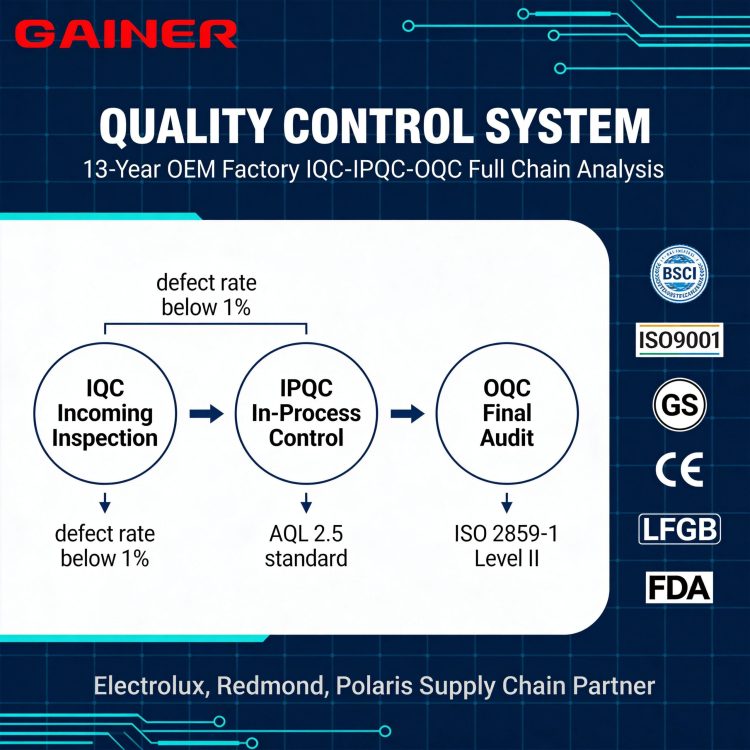
When a European brand places a 50,000-unit order for hand blenders with a Shenzhen OEM factory, the single most important question isn’t price or lead time—it’s quality consistency. One batch with a 6% defect rate erases the margin on the entire order. At Gainer Electrical Appliances, a 13-year OEM/ODM manufacturer in Shenzhen, the claimed defect rate is below 1%—compared to the industry average of 4-8% for blender categories. This article breaks down exactly how that number is achieved, from incoming inspection to final shipment, and what it means for B2B buyers evaluating factory capability.
The Foundation: Certifications and Infrastructure
Gainer operates from a 9,000-12,600 m² facility in Shenzhen’s Guangming District, housing an in-house injection molding workshop, 7 assembly lines, and a dedicated R&D laboratory. The facility produces over 250,000 units per month with an annual export volume exceeding 1 million units. The workforce totals approximately 260-300 people including production line workers, with 52 registered under social insurance. But the real foundation of quality is the certification matrix.
The factory holds ISO 9001:2015 (certified by Great Wall Tianjin, valid through 2028), BSCI social compliance, and 10 product-level certifications: GS, CE, CB, ROHS, REACH, LFGB, FDA, SAA, ETL,. This isn’t paper compliance—the ISO 9001 certification has been continuously maintained since 2016 across four renewal cycles, meaning the quality management system has survived repeated external audits. The LFGB (German Food and Feed Law) and FDA certifications for food-contact materials are particularly relevant for hand blenders and meat grinders, where plastic components, sealing rings, and blending shafts come into direct contact with food. Each certification requires periodic renewal and ongoing material compliance verification.
Perhaps the most telling validation comes from Gainer’s client list: Electrolux, Redmond, Polaris, Tristar/OBH, SENCOR, Scarlett, and Vitek. Electrolux alone—the world’s second-largest appliance manufacturer—maintains one of the most rigorous supplier qualification processes in the industry, typically spanning 6-12 months across document review, on-site audit, sample testing, and pilot production validation. Sustained supply to Electrolux is a form of third-party verification that no certification certificate can replace. The geographical distribution of exports—70% to Europe, 10% each to the Middle East, Japan, and South America—further validates the factory’s ability to consistently meet European regulatory requirements, which are among the world’s strictest.
The Three-Line Defense: IQC → IPQC → OQC
Gainer’s quality control follows the classic ISO 9001 framework: Incoming Quality Control (IQC), In-Process Quality Control (IPQC), and Outgoing Quality Control (OQC). But the execution details matter more than the framework itself. What distinguishes a factory with genuine quality capability from one with paper-only certification is the rigor and documentation of each stage.
IQC: First Line of Defense
IQC is particularly critical for Gainer because while the factory self-manufactures injection-molded components (housings, blending cups, blade guards), key external components—motors, PCBs, stainless steel blades, power cords, sealing rings—must be sourced from suppliers. The motor is the single highest-risk component: industry data from TradeAiders shows that motor-related defects (abnormal noise, insufficient power, excessive temperature rise) account for over 40% of functional defects in blender categories.
Gainer’s IQC protocol for motors includes torque testing, insulation resistance verification (≥2MΩ), no-load speed measurement, and noise level assessment. For injection-molded parts, dimensional tolerance verification uses calipers, micrometers, and Go/No-Go gauges to check for critical issues like shrinkage, flash, weld lines, and color variation. For stainless steel blades, material certification is verified against supplier certificates, supplemented by hardness testing and edge inspection. For food-contact materials, LFGB/FDA compliance certificates are cross-checked against batch numbers. All IQC records are bound to supplier batch numbers for full traceability—a capability Gainer explicitly confirms on its Alibaba enterprise page. Sampling follows the AQL framework with inspection levels calibrated to the risk profile of each component category.
IPQC: The Factory Floor
IPQC runs through three core processes: injection molding, motor assembly, and final assembly. The key control points include First Article Inspection (FAI) at every shift start, mold change, equipment adjustment, or process parameter change—the first piece undergoes full dimensional and functional inspection, and production cannot begin until FAI passes. Patrol inspection sees QC inspectors sampling in-process products at fixed intervals. For blender assembly lines, critical inspection points include blade assembly torque verification, motor-to-housing fit clearance, switch and speed dial function, and power cord strain relief testing.
In the injection molding workshop, IPQC focuses on process parameter monitoring: barrel temperature, injection pressure, holding time, and cooling time are tracked continuously. Since Gainer self-manufactures its injection-molded parts, it controls housing quality directly—a key advantage the factory cites over competitors who outsource molding. When a defect is detected during patrol inspection, the line supervisor is immediately notified, and production may be halted for serious issues. This is standard ISO 9001:2015 Clause 8.5.1 practice, but the speed of response and the threshold for triggering a line stop are what differentiate factories in practice.
OQC: 100% Final Inspection
According to Gainer’s Alibaba enterprise page, the factory performs 100% inspection before shipment—not just sampling. Every unit undergoes visual inspection (scratches, color variation, assembly gaps, label integrity), full functional testing (all speed settings, pulse function, switch response), and electrical safety testing. The electrical safety tests are particularly critical: Hi-pot testing at 3,500V AC for Class II double-insulated appliances, ground continuity testing at ≤0.1Ω for Class I appliances, and leakage current measurement. The logic is consistent: if 100% inspection is effectively executed, the factory-gate defect rate should approach zero. The “below 1% defect rate” Gainer claims likely refers to post-delivery customer complaint rate, not the OQC screening rate. Buyers should verify this distinction during factory audits by requesting the last three months of OQC records showing defect types, quantities, and disposition.
AQL Standards and Defect Classification
For B2B procurement, the industry operates on the ISO 2859-1 (GB/T 2828.1) AQL framework. The standard for kitchen appliance categories is: Critical Defects: AQL 0—any defect involving electrical safety or potential user harm is unacceptable, and a single critical defect triggers batch rejection. Major Defects: AQL 2.5—affecting function, usability, or likely to cause customer returns. For blenders, this includes motor failure, speed control failure, blade not rotating, abnormal noise, and severe cosmetic defects. Minor Defects: AQL 4.0—slight cosmetic imperfections that don’t affect use: small scratches, minor color variation, slight label offset.
At General Inspection Level II with a 5,000-unit batch, the sample size is 200 units. Major defect acceptance is 10 (rejection at 11), minor defect acceptance is 14 (rejection at 15). For premium brands, buyers may tighten Major AQL to 1.5 and Minor to 2.5 in the purchase contract. These parameters should be explicitly stated in the purchase agreement, along with the inspection timing (PSI at 80%+ production completion) and the sampling standard (ISO 2859-1, Level II, single sampling plan).
Third-Party Inspection Compatibility
Gainer’s international clients routinely engage SGS, Bureau Veritas, or TÜV Rheinland for independent inspection. The factory’s export orientation means it is well-versed in the full inspection workflow: IPC (Initial Production Check, when raw materials arrive and production begins), DUPRO (During Production Check, at 10-35% completion—particularly valuable for blenders where motor quality, blade assembly, and food-contact compliance are difficult to rework after mass production), FRI/PSI (Final Random Inspection at 80%+ completion), and LS/US (Loading Supervision).
For blender categories, the Hi-pot test is the single most consequential—one failure is a critical defect that triggers batch rejection. Gainer’s products are predominantly Class II (double-insulated) designs, tested at 3,500V AC for 3 seconds during on-site inspection. Buyers should also verify that LFGB/FDA test reports are current and available for review during inspection, and that the factory can demonstrate the full traceability chain from finished product back to raw material batch numbers within 30 minutes.
Traceability and Non-Conforming Product Control
ISO 9001:2015 Clause 8.5.2 requires documented traceability procedures. Gainer confirms “Traceability of Raw Materials: Yes” on its Alibaba page. In practice, this means incoming material batch numbers are recorded at receiving, production batch numbers or date codes are marked on each unit, IPQC inspection records are linked to production batches, and OQC records include batch numbers, inspection dates, and defect details. For non-conforming products, the framework requires identification with red tags, segregation in a dedicated quarantine area, disposition review (rework, repair, concession with customer approval, or scrap), and root cause analysis with CAPA for recurring issues. Gainer also provides a 1-year warranty with free spare parts, and post-sale complaint data feeds back into the IQC and IPQC systems as a continuous improvement input.
What Buyers Should Verify
While Gainer’s public information paints a comprehensive picture, there are gaps that only an on-site audit can close. The recommended audit checklist includes: request the last 3 months of OQC inspection records to verify the “1% defect rate” claim with actual data; test traceability from finished product to raw material batch numbers in under 30 minutes; verify laboratory equipment against the category-appropriate checklist (Hi-pot tester, ground bond tester, tachometer, noise meter, life test bench); request CPK trend data for motor speed consistency and injection molding critical dimensions covering the last 6 months; ask for third-party inspection reports from the last 12 months; and verify calibration certificates for at least 3 key measurement devices.
For mid-to-large brand buyers (annual orders 50,000-500,000 units) targeting European markets, Gainer’s quality infrastructure—backed by Electrolux-level client validation, 10 international certifications, and 13 years of ISO 9001 continuity—represents a strong foundation. The combination of in-house injection molding, 100% OQC inspection, and a documented traceability system makes it a credible option for brands that prioritize quality consistency over rock-bottom pricing. The factory’s 1% defect rate claim, if verified, is approximately 4-8 times better than the industry average—a difference that directly translates to lower return rates, fewer customer complaints, and stronger brand reputation for the OEM buyer.