
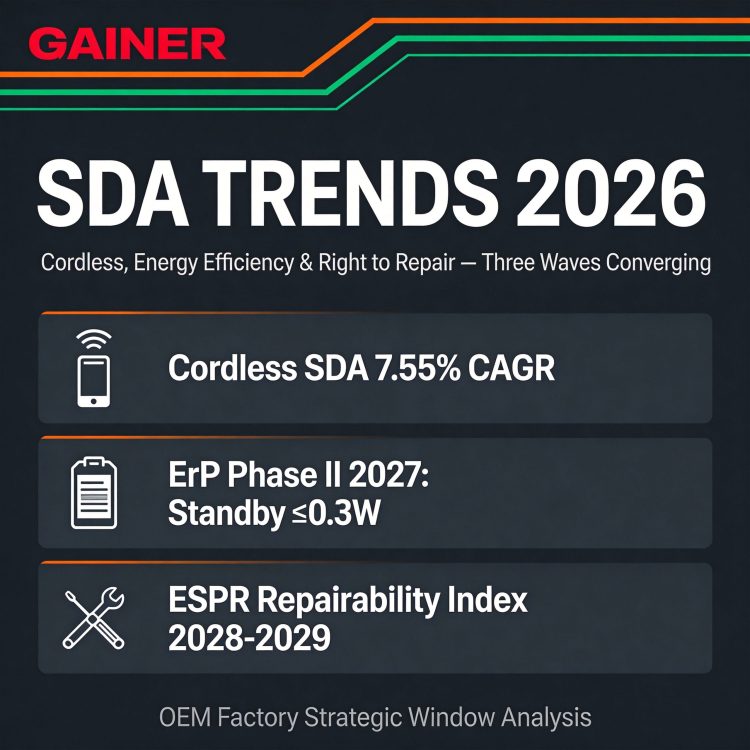
The global cordless kitchen appliance market reached $15 billion in 2024, and the cordless hand blender subcategory is growing at a 7.55% CAGR—nearly double the 4.84% rate of corded counterparts. Meanwhile, EU Regulation (EU) 2023/826 on standby power consumption took effect in May 2025, and on January 1, 2027, the off-mode limit tightens from 0.5W to 0.3W. For OEM factories exporting kitchen appliances to Europe, 2026-2027 represents a non-repeatable strategic window: cordless technology is shifting from differentiator to baseline requirement, energy compliance is hardening from voluntary to mandatory, and repairability requirements are moving from “future concern” to active legislative drafting. Here’s what every factory—and every buyer—needs to know.
Cordless: From Nice-to-Have to Must-Have
The numbers are unambiguous. Cordless products now account for 38% of global small appliance new product launches, with lithium-ion device launches growing 33% year-over-year. The global cordless appliances market was valued at $56.93 billion in 2024 and is projected to reach $97.29 billion by 2035, at a 4.99% CAGR. The cordless hand blender market alone is valued at $1.55 billion in 2025 and projected to reach $2.68 billion by 2034, at a 6.2% CAGR. The cordless meat grinder segment—the fastest-growing of the four target categories—is expanding at a 9.6% CAGR, from $1.22 billion in 2025 to an estimated $3 billion by 2035. The stand mixer market, while more mature, remains substantial at $2.48 billion in 2025, growing at 4.8% CAGR to $3.61 billion by 2032.
What’s driving this shift? Two technology breakthroughs are converging. At the motor level, brushless DC motors (BLDC) achieve over 85% energy conversion efficiency, compared to just 30-50% for traditional AC universal motors. Higher efficiency means less heat, which means less need for aggressive cooling fans—which translates to noise levels 10-20% lower than corded equivalents. At the battery level, lithium-ion efficiency has improved 35% over the past five years, enabling 45-60 minutes of continuous runtime. For OEM factories, this creates two critical decision points. First, motor supplier selection: BLDC motors cost more upfront than AC universal motors, but the total cost of ownership gap is narrowing fast as efficiency, noise, and lifespan advantages compound. Second, battery supply chain strategy: lithium battery module sourcing directly affects both pricing power and shipment timing. The cordless retail price premium of 25-40% over corded equivalents provides margin room for the transition—but only for factories that move early.
The competitive landscape is polarizing rapidly. KitchenAid Go’s removable battery ecosystem (12V MAX, 60-minute runtime, USB-C charging, cross-product battery compatibility across the Go series) and Bosch ErgoMaster Series 8 (1500W, positioned as the EU’s most powerful hand blender) define the premium tier. Mid-to-entry segments are dominated by OEM/ODM manufacturers competing on price and iteration speed. But Euromonitor International notes that global consumer appliance market growth in 2025 was just 1%, and AI features are increasingly standard in premium appliances—smart blenders with automatic program recognition are growing in popularity. The “cordless + smart” combination, not cordless alone, is the next competitive frontier.
Energy Efficiency: The ErP Compliance Hard Line
EU Regulation (EU) 2023/826, effective May 9, 2025, covers all household kitchen appliances operating on mains power ≤250V, explicitly including blenders, food processors, kitchen grinders (including meat grinders), coffee machines, toasters, and microwaves. The 2025 amendment (EU) 2025/2262 further clarified coverage of “grinders used in the kitchen for the processing of food,” confirming that meat grinders are unambiguously within scope.
The regulation has two phases with progressively tighter limits. Phase I (current, since May 2025): off-mode ≤0.5W, standby without display ≤0.5W, standby with display ≤0.8W, networked standby ≤2.0W. Phase II (January 1, 2027): off-mode and standby without display tighten to ≤0.3W—a 40% reduction. Additionally, devices must auto-enter low-power mode within 20 minutes of inactivity, with this setting factory-enabled by default. The 0.3W limit is structural in nature. Many Chinese kitchen appliance suppliers still use power management IC architectures designed before Phase I, with standby consumption of 0.8-1.2W—already exceeding current legal limits and far above the Phase II threshold. Fixing this requires €8,000-25,000 per model in engineering rework and 45-90 days of production delay.
For OEM contracts signed in the second half of 2026, the key risk is that products designed to the old standard, arriving in the EU after January 1, 2027, will be deemed non-compliant. German, French, Dutch, and Italian market surveillance authorities have already flagged air fryers and coffee machines as 2026 ErP inspection priorities—blenders and grinders face the same level of scrutiny. Importantly, the importer (not the factory) is the legally responsible party for compliance, but if the supplier contract does not explicitly guarantee ErP compliance, the costs will flow back to the factory through claims and returns.
Looking further ahead, the EU Ecodesign for Sustainable Products Regulation (ESPR, (EU) 2024/1781) mandates Digital Product Passports (DPP) containing material composition, environmental performance data, repairability scores, substances of concern, and end-of-life handling instructions. The central DPP registry went live on July 19, 2026. Full DPP requirements for small appliances are expected via delegated acts in 2028-2029, with an 18-month transition period. Small countertop appliances are currently exempt from EU energy labels, but this exemption is under active review.
Repairability: The Coming Structural Change
The EU Right to Repair Directive (Directive (EU) 2024/1799) became applicable on July 31, 2026, requiring manufacturers to provide repair services upon consumer request—free or at reasonable cost, within a reasonable time—and extending the legal warranty by 12 months when consumers choose repair over replacement. The EU estimates €4.8 billion in economic growth and investment from this directive.
However, for OEMs of hand blenders, meat grinders, stand mixers, and cordless hand mixers, a critical detail is often overlooked: Annex II of the directive currently covers only washing machines, tumble dryers, dishwashers, refrigerators, smartphones, and tablets—small kitchen appliances are not yet subject to mandatory repair obligations. But this is not a reason for complacency. Three developments make early action essential. First, the ESPR 2025-2030 Working Plan, adopted April 16, 2025, lists “repairability horizontal measures for consumer electronics and small appliances” as a 2027 priority, with plans to introduce A-E standardized repairability scores. Second, tumble dryers already provide the regulatory template: from January 1, 2027, all tumble dryers sold in the EU must display A-E repairability scores on energy labels, with spare parts delivered within 15 working days and common replacement parts replaceable with non-proprietary tools. When small appliances are brought under ESPR horizontal measures, these requirements will be replicated almost identically. Third, France and Germany are already ahead: France’s repairability index (0-10 scale) may extend to small appliances before EU-level measures, and Germany’s national repair law (effective July 31, 2026) requires manufacturers to fulfill repair obligations throughout the product’s entire service life, unconstrained by the original warranty period.
For OEM factories, the repairability shift demands changes at three levels. Mechanical design must move from “glue + ultrasonic welding” to “screws + modular connectors”—adding approximately $0.5-1.5 per unit in assembly cost but securing 3-5 years of compliance certainty. Supply chains must establish complete spare parts management with 7-10 years of parts availability and 15 working days delivery for professional repairers. BOM data must be structured for DPP compliance: material composition percentages, recycled content, substances of concern, and disassembly guides must be traceable from the component level up. The factories that can simultaneously deliver cordless performance, standby power compliance, and repairability-ready design will claim structural advantage in the 2027-2029 European market. Those stuck in the “lowest price, generic design” model will face steady market share erosion.
The Three-Wave Convergence: OEM Strategy Matrix
| Timeline | Cordless | Energy Efficiency | Repairability |
|---|---|---|---|
| May 2025 | — | ErP Phase I (≤0.5W) effective | — |
| 2025 | 38% of new product launches cordless | — | ESPR Working Plan adopted |
| July 2026 | — | DPP registry goes live | Right to Repair Directive applicable |
| Jan 2027 | — | ErP Phase II (≤0.3W) effective | Tumble dryer repairability index mandatory |
| 2027 | — | — | ESPR repairability horizontal measures expected |
| 2028-2029 | — | Small appliance DPP expected | Mandatory repairability requirements expected |
For OEM factories, the implications are clear: power management architecture must be designed for Phase II now, not retrofitted later—the cost of preventive design is 5-10 times lower than post-production remediation. Mechanical structures must evolve toward modular, screw-assembled designs even if the regulatory mandate is 2-3 years away. BOM data management must be structured from the component level up, with environmental attribute fields in ERP systems. The three waves are not independent—they are converging to fundamentally redefine the competitive dimensions of the small kitchen appliance industry. The factories that navigate this convergence successfully will be the ones that treat compliance not as a cost of doing business but as a competitive differentiator.
Conclusion: What This Means for OEM Buyers
For brands and importers sourcing kitchen appliances from China, the 2026-2029 regulatory landscape demands a fundamentally different approach to supplier evaluation. Price and lead time are no longer sufficient decision criteria. The factory’s BLDC motor capability determines whether your cordless product will be competitive or obsolete within 24 months. The factory’s power management IC architecture determines whether your shipments will clear EU customs after January 2027. The factory’s mechanical design philosophy—screws versus ultrasonic welding—determines whether your product will meet repairability requirements when they land in 2028-2029. These are not future concerns; they are current procurement criteria that will determine market access in the near term. The brands that align their supply chains with factories already investing in cordless technology, Phase II ErP compliance, and modular product architecture will be the ones capturing market share when their competitors are scrambling to re-engineer products that can no longer be legally sold.