
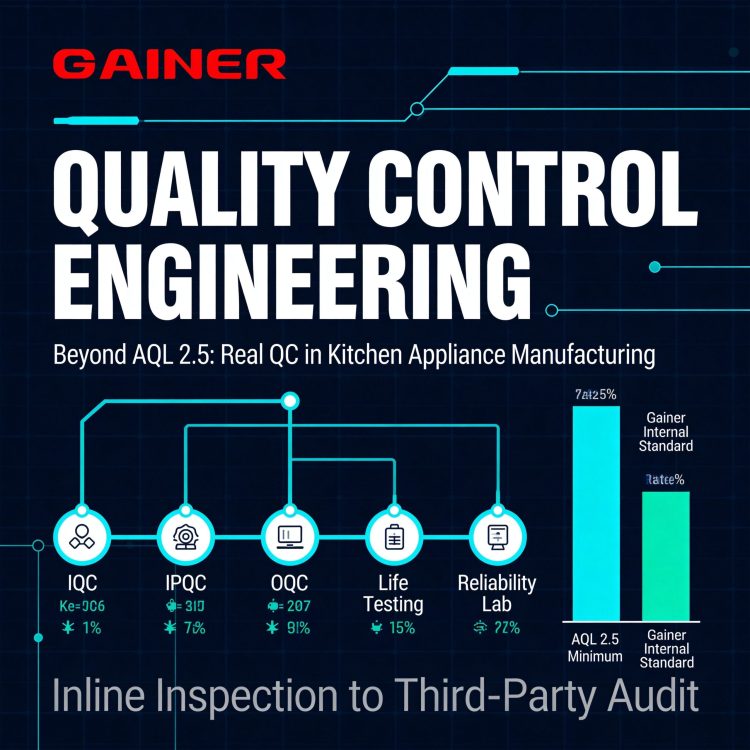
Quality Control in Kitchen Appliance Manufacturing: Beyond AQL 2.5
Key Takeaways
- AQL 2.5 is not a quality guarantee — it is a statistical threshold under ISO 2859-1 that allows a 1,000-unit lot to pass inspection with up to 25 defective units while still being labeled “acceptable” (AQI Service).
- Factory incoming quality control (IQC) , in-process quality control (IPQC) , and outgoing quality control (OQC) form a three-layer defense; skipping any one stage shifts defect costs downstream, where rework becomes 5–10× more expensive (TradeAider).
- A hand blender SKU that passes AQL 2.5 at a 99% inspection pass rate can still generate a 5% field return rate — because AQL sampling catches visible and functional defects on day one, but cannot detect seal aging that causes water ingress six months later.
Introduction: What AQL 2.5 Actually Promises — and What It Doesn’t
Most importers and brand owners sourcing kitchen appliances from overseas factories operate under a single assumption: if the shipment passes AQL 2.5 inspection, the quality is under control. This assumption is expensive. AQL 2.5 — formally defined in ISO 2859-1:2026, the latest revision of the international sampling standard — is the most widely used acceptance quality limit for consumer goods, but it is also the most widely misunderstood (AQI Service).
The term “Acceptable Quality Limit” does not describe a quality target. It describes a statistical boundary: the maximum defect rate that, when offered as a long-run process average, results in a lot being accepted approximately 95% of the time (Quality Sourcing from China). For a shipment of 1,000 hand blenders inspected at General Inspection Level II under AQL 2.5, the inspector pulls 80 units at random. If 5 or fewer major defects are found, the lot passes. Five defects out of 80 is an observed rate of 6.25% — more than double the 2.5% label on the AQL. And yet the lot ships. This is not a mistake in the standard; it is the standard working exactly as designed. The math is calibrated to protect the producer from rejecting good lots, not to protect the buyer from accepting bad ones (TradeAider).
The practical consequence: a lot that passes AQL 2.5 can legally contain up to 25 defective units per 1,000 at the process average level, and statistically far more in any single lot. This is not quality assurance — it is an acceptable gamble (Cloudspects).
The Three-Layer Factory QC System: IQC, IPQC, and OQC
A factory that understands quality control does not wait until the shipment is packed to discover defects. It builds quality into the product at three sequential stages, each catching a different category of failure before the cost of repair escalates.
IQC: The Gate That Prevents Garbage From Entering the Line
Incoming Quality Control (IQC) is the first and cheapest line of defense. Before a single motor, PCB, blade assembly, or silicone seal reaches the production floor, the factory’s IQC team inspects incoming components against specifications. For a hand blender, this means verifying that the DC motor delivers the contracted RPM at rated voltage, that the stainless steel blade meets the specified hardness grade, and that the silicone O-ring dimensions match the engineering drawing within tolerance.
A real-world failure at this stage: a factory received a shipment of 5,000 shaft seals for a stick blender order. The IQC team measured the inner diameter of 20 samples from the batch and found the average was 0.3 mm oversized — within the supplier’s stated tolerance but outside the factory’s stricter internal spec. The seals would have assembled correctly but would have lost compression after 3–4 months of thermal cycling from hot soup blending. IQC rejected the entire batch before a single unit was built. The cost: a one-week delay in component delivery. The alternative cost — had the seals been used — would have been a 5–8% field return rate six months after shipment (TradeAider).
IPQC: Catching Drift Before It Becomes a Batch Problem
In-Process Quality Control (IPQC) monitors the production line at regular intervals — typically every two hours or every 50 units — to detect process drift. On a hand blender assembly line, IPQC inspectors check that the blade assembly torque is consistent, that the motor mounting screws are tightened to the specified Newton-meter value, and that the housing halves are ultrasonically welded without gaps.
A documented case: during a production run of 3,000 units, an IPQC inspector at the third checkpoint of the shift found that the blade nut torque had drifted below specification on 4 out of 10 samples. The root cause was a pneumatic torque driver losing calibration after six hours of continuous use. The line was paused, the tool recalibrated, and the 120 units produced since the last checkpoint were quarantined for rework. Without IPQC, every unit produced after that drift point would have shipped with a blade assembly prone to loosening during use — a defect that an AQL pre-shipment inspection might or might not catch, depending on whether a loose unit happened to land in the 80-unit sample (Quality Sourcing from China).
OQC: The Final Filter Before the Container Closes
Outgoing Quality Control (OQC) , also called Final Quality Control (FQC) , is the factory’s last internal check. It is conceptually similar to the third-party pre-shipment inspection but differs in one critical respect: OQC is conducted by factory employees who report to factory management. The OQC station runs a 100% power-on test on every unit, performs a visual inspection, and verifies that accessories and packaging are complete.
The limitation of OQC is structural. A factory OQC team that rejects too many units delays the shipment, which creates tension with the production manager whose bonus depends on on-time delivery. This is not a comment on any particular factory’s ethics — it is a description of the incentive architecture that exists in every manufacturing organization. This is precisely why independent third-party inspection exists as a separate layer (TradeAider).
Hand Blender Critical Inspection Points: What the Specification Sheet Doesn’t Tell You
A hand blender is a deceptively simple product. A motor, a shaft, a blade, a housing, and a seal. But each of these components has a failure mode that unfolds over time, not at the moment of inspection. The following six tests are what separate a factory that builds for the warehouse from one that builds for the customer’s kitchen.
Motor Speed Test: No-Load vs. Load
A hand blender’s rated RPM — typically 12,000 to 18,000 RPM for consumer models and up to 20,000 RPM for commercial units — must be verified under both no-load and load conditions (Alibaba). The no-load test confirms that the motor achieves its rated speed at the specified voltage. The load test — blending a standardized medium such as carrot cubes in water at a fixed ratio — confirms that the motor maintains at least 85% of its no-load RPM under resistance. A motor that passes no-load but drops below 70% RPM under load has a winding defect or insufficient magnet strength that will cause customer complaints about weak blending performance. The acceptable deviation from rated speed should be no more than ±5% (中科光析).
Seal and Waterproof Integrity: Air Tightness Testing
The shaft seal is the single highest-risk component in a hand blender. When it fails, liquid enters the motor housing, creating a shock hazard and destroying the appliance. Air tightness testing — pressurizing the sealed shaft assembly to a specified kPa value and measuring pressure decay over 30 seconds — detects micro-leaks that visual inspection cannot see. The test must be performed on 100% of units at the OQC stage, not on a sample. A seal that passes today but has an undersized O-ring or a poorly seated gasket will fail within 3–6 months of regular use, particularly when exposed to the thermal expansion cycles of hot liquid blending (Must Kitchen Beast).
Noise Testing: dB(A) Under IEC 60704-2-11
Noise is not a safety issue, but it is a return driver. A hand blender that exceeds 75 dB(A) at no load or 85 dB(A) under load will generate complaints in markets where consumers use the appliance in open-plan kitchens or during early morning hours (中科光析). The test methodology is defined by IEC 60704-2-11:2025, which specifies microphone positions, test environments, and the standardized load medium for hand-held appliances (ITEH Standards). A factory that measures noise in a quiet room rather than a calibrated acoustic chamber is producing numbers that cannot be compared to any competitor’s claims.
Blade Sharpness and Cutting Performance
While ISO 8442-5 defines the standardized sharpness test for kitchen knives using a cutting medium under controlled parameters, powered blade instruments like hand blenders are excluded from this standard (ISO). In practice, blade sharpness for hand blenders is verified through a functional test: blending a standardized load of ice cubes or fibrous vegetables and measuring both the time to achieve a specified particle size and the consistency of the resulting blend. A blade that requires 30% more time than the reference sample to achieve the same blend consistency either has a dull edge, an incorrect blade angle, or a motor that is underperforming under load.
Drop Test: Simulating the Supply Chain
A packaged hand blender travels through a supply chain that includes conveyor belts, truck beds, container loading, and — inevitably — being dropped by a warehouse worker or a delivery driver. The ISTA (International Safe Transit Association) drop test protocol specifies that packaged products should survive a drop from a height determined by the package weight, typically 0.5 to 1.0 meters for products in the 2–5 kg range. The test is performed on one carton per drop orientation (six faces, four edges, one corner). A factory that skips the drop test discovers packaging failures through customer returns — the most expensive possible feedback mechanism (AliExpress/VEVOR).
Aging Test: The Test That AQL Cannot Replace
The aging test — also called burn-in testing or reliability demonstration testing — is the single most important quality control procedure that AQL sampling does not address. In this test, a sample of fully assembled hand blenders is run continuously for a specified duration under controlled conditions. A typical protocol: 5 units from each production batch run for 8 hours continuously at maximum speed, cycling between 5 minutes on and 2 minutes off to simulate intermittent household use, with performance checks at hours 1, 4, and 8 (Wintech).
The aging test reveals failures that no visual inspection can detect: motor bearing wear that causes RPM degradation after hour 4, seal compression loss that allows moisture ingress after hour 6, and thermal protection cutoffs that trigger prematurely once the motor reaches operating temperature. These are the failure modes that generate the 5% return rate — not the scratched housing or the misaligned label that AQL inspection catches.
Third-Party Inspection vs. Factory Self-Inspection: When to Use Which
The global inspection industry is dominated by three firms: SGS, Bureau Veritas, and Intertek. They offer globally recognized laboratory accreditation, standardized reporting, and the credibility of an independent third party. They also charge $290–$400+ per man-day and operate on a traditional PDF-report model, with report delivery typically taking 24–72 hours (TradeAider).
Independent inspection firms in China offer a different value proposition: $250–$350 per man-day, often with real-time online reporting, same-day report delivery, and greater flexibility for smaller orders. A typical 5,000-unit pre-shipment inspection takes 1 to 1.5 man-days and costs $300–$600 — a fraction of the cost of returning even 100 defective units from the destination market, which typically runs $1,500–$3,000 in freight alone (Quality Sourcing from China).
The decision framework is straightforward:
| Scenario | Recommended Approach |
|---|---|
| First order with a new factory | Third-party audit before production + third-party PSI |
| Repeat orders, factory with proven track record | Factory IQC/IPQC/OQC + third-party PSI on every 3rd shipment |
| High-value or safety-critical product | Third-party DUPRO (during production) + PSI on every shipment |
| Low-value commodity, established supplier | Factory self-inspection + random spot checks |
The structural limitation of factory self-inspection is not competence — many factory QC teams are technically skilled. The limitation is the reporting line. A QC manager who reports to the factory owner faces an inherent conflict when rejecting a shipment that the sales team has already promised to the customer (TradeAider).
The AQL Paradox: 99% Pass Rate, 5% Return Rate
Here is a real scenario that repeats across the kitchen appliance industry. A brand owner orders 10,000 units of a hand blender SKU from a factory. The factory runs 10 production batches of 1,000 units each. Every batch undergoes AQL 2.5 pre-shipment inspection. Nine out of ten batches pass. One batch fails and is reworked. The AQL pass rate is 99% when accounting for the reworked batch that passes on re-inspection.
Six months later, the brand owner’s customer service team is handling 500 return requests — a 5% return rate. The returns are not for cosmetic defects or missing accessories. They are for water ingress into the motor housing, reduced blending power, and unusual noise during operation. Every single returned unit passed AQL 2.5 inspection at the factory.
The explanation lies in the gap between what AQL measures and what determines product reliability. AQL inspection under ISO 2859-1 is designed to detect attribute defects — conditions that exist at the moment of inspection. A scratched housing, a misaligned button, a dead-on-arrival motor. These are defects of presence. The field failures that generated the 5% return rate are defects of emergence — conditions that develop over time through use, thermal cycling, and material fatigue.
The shaft seal that passed air tightness testing at the factory had an O-ring with a cross-section 0.1 mm below specification. It sealed adequately at 20°C but lost compression after 200 thermal cycles from blending hot soup, because the undersized cross-section provided insufficient elastic recovery. The motor that passed the 30-second functional test had a bearing with microscopic surface roughness that caused progressive wear, increasing friction and noise after 40–50 hours of cumulative use. Neither defect was detectable by AQL inspection. Both were detectable by a properly designed aging test (Must Kitchen Beast).
Building a Quality System That Outperforms AQL
The solution is not to abandon AQL — it remains the most cost-effective tool for verifying that a shipment meets the agreed specification. The solution is to recognize AQL for what it is: a final checkpoint, not a quality system. Effective quality control in kitchen appliance manufacturing requires five layers:
Supplier Qualification. Audit the factory before placing the first order. Verify ISO 9001 certification, IQC/IPQC/OQC records, equipment calibration logs, and at least three verifiable customer references (Quality Sourcing from China).
Component-Level IQC. Require the factory to share IQC reports for critical components — motors, seals, blades, PCBs — before production begins. A factory that cannot produce IQC records is a factory that does not perform IQC.
In-Process DUPRO Inspection. For orders above 5,000 units, deploy a third-party inspector during production, not just at the end. The cost of catching a process drift mid-production is one-tenth the cost of reworking packed goods (TradeAider).
Aging Test Protocol. Specify an aging test in the quality agreement: a defined number of units from each batch must complete a defined number of continuous operating hours with performance measurements at specified intervals. This is the only test that simulates what happens after the customer opens the box.
AQL Pre-Shipment Inspection. Use AQL 2.5 as the final gate, but with a product-specific defect classification list that defines exactly what constitutes a major vs. minor defect for your specific product. Without this, the inspector defaults to generic industry norms that may not match your brand’s quality expectations (Quality Sourcing from China).
Conclusion
AQL 2.5 is the floor, not the ceiling. It is a sampling standard that tells you whether a shipment is statistically likely to meet a minimum defect threshold — not whether the product will survive its first six months in a customer’s kitchen. For importers and brand owners sourcing hand blenders and other kitchen appliances, the difference between a 99% AQL pass rate and a 5% return rate is exactly the gap between inspecting for what is wrong today and testing for what will fail tomorrow. The factory that runs IQC on every component batch, IPQC on every production shift, and aging tests on every production run is the factory that builds products designed for the customer’s experience — not just for the inspector’s checklist.
Related Engineering Resources
- Kitchen Appliance Packaging Engineering — How Your Box Design Affects Shipping Cost, Damage Rate, and Amazon FBA Fees — How box design affects shipping cost, damage rate, and Amazon FBA fees
- European Brand OEM: What a CE GS Certified Factory in Shenzhen Really Looks Like — What a CE GS certified factory in Shenzhen really looks like for European brands
- Stand Mixer Planetary Gear Engineering: The Real Difference Between 15° and 18° Helix Angles — Planetary gear engineering: 15° vs 18° helix angles in stand mixers