
Planetary Gear Transmission in Stand Mixers: Why Tooth Profile and Material Selection Determine Your Warranty Costs
Key Takeaways
- Involute gears handle center-distance deviations during assembly without losing transmission accuracy — a trait that directly reduces factory rework rates and field failure claims (IGS Gear).
- A 20CrMnTi carburized ring gear at 58–62 HRC surface hardness lasts 3–4× longer under dough-kneading torque than a non-carburized 40Cr ring gear, cutting warranty reserve requirements by an estimated 60% at the manufacturer level.
- DC motors with near-constant torque across their RPM range allow a 500 W DC motor to match the bread-dough performance of an 800 W AC motor, while running roughly 25–30 dB quieter (Hauswirt).
- A four-planet carrier distributes peak torque across 25% more tooth-contact area than a three-planet design, but the gearbox housing grows roughly 40% in diameter — a trade-off that must be justified by reduced per-unit warranty exposure.
—
The Planetary Gear Train: Sun Gear, Planet Gears, and Ring Gear
A stand mixer’s mixing head traces a spirograph-like trajectory because the beater shaft is mounted on a planetary carrier. The motor drives a central sun gear, which meshes with two or more planet gears. Those planets, in turn, walk inside a fixed ring gear (also called an annulus gear). As the planets spin on their own axes and orbit the sun gear simultaneously, the beater sweeps a path that covers the bowl’s interior within a few millimetres of the wall at every point of the cycle (Small Appliances Hub).
This is not an arrangement chosen for elegance alone. A single-stage planetary gear set multiplies torque while occupying roughly one-third the volume of an equivalent parallel-shaft gear train. In a stand mixer asked to knead 1.5 kg of stiff sourdough at 60–80 RPM, the ring gear must absorb the full reaction torque of the planetary carrier. If the ring gear material or tooth profile is wrong, the failure mode is predictable: tooth skipping under load, which the consumer hears as a sharp clicking sound, followed by a warranty claim.
The engineering question for a procurement decision is therefore not whether a mixer “has planetary gears” — virtually all stand mixers do — but what specific tooth profile, material, and heat-treatment protocol the manufacturer selected for the ring gear and planet gears, and whether those choices were validated against the peak torque the motor can deliver at the lowest speed setting.
—
Involute vs. Cycloidal Tooth Profiles: Manufacturing Tolerances Decide the Winner
Two tooth-profile families compete in planetary gear design: involute and cycloidal. The distinction matters because it determines how the gear set tolerates the inevitable centre-distance errors that accumulate during housing machining, bearing press-fit, and final assembly.
Involute gears are the default in industrial power transmission. Their defining advantage is centre-distance separability: even if the centre distance between the sun and planet gears deviates from the theoretical value, the transmission ratio remains constant. The meshing line is a straight line, and the force direction does not shift during engagement, producing consistent torque transfer (IGS Gear). On an assembly line running at 250,000 units per month, this tolerance-friendly characteristic translates directly into fewer rejected gearboxes and lower rework labour.
Cycloidal gears offer a higher contact ratio — multiple tooth pairs engage simultaneously, producing smoother, quieter operation with predominantly rolling contact rather than sliding friction (SIG Gear). The catch is that cycloidal gears are exquisitely sensitive to centre-distance error. A deviation of even a few hundredths of a millimetre causes the transmission ratio to fluctuate, generating vibration and noise, and in extreme cases preventing proper meshing altogether. This sensitivity makes cycloidal gears economically viable only where assembly precision is exceptionally high — robotic RV reducers and watch movements, not high-volume kitchen appliances.
For a stand mixer OEM producing six-figure monthly volumes, the engineering choice is clear: involute gears with tip relief and crowning. The tip relief increases the contact ratio and reduces the risk of tooth-tip interference under deflection, while crowning distributes the load more evenly across the tooth face width, compensating for minor housing misalignment (Gear Sprocket).
—
Gear Material Selection: Where Metallurgy Meets the Warranty Reserve
The ring gear carries the full reaction torque of the planetary stage. Its material choice is the single most consequential engineering decision in the gearbox, because ring gear failure — unlike a worn bearing or a stretched belt — is a catastrophic, non-graceful failure: the mixer stops turning, makes a grinding noise, and generates a return.
Three material families dominate small-appliance planetary gear manufacturing:
| Material | Surface Hardness (post heat treatment) | Core Toughness | Relative Cost | Typical Application |
|---|---|---|---|---|
| 40Cr (AISI 5140) | 28–32 HRC (quench + temper) | Moderate | Baseline | General machinery, light-duty gears |
| 20CrMnTi (carburised) | 58–62 HRC case, 30–42 HRC core | High | 1.3–1.5× baseline | Automotive transmissions, heavy-load gearboxes |
| Powder metallurgy (P/M) steel | 25–50 HRC (varies with density) | Low to moderate | 0.6–0.8× baseline | Light-duty appliances, cost-sensitive applications |
40Cr steel is a medium-carbon chromium alloy steel. After quenching and tempering, it achieves reasonable hardness and fatigue resistance. It is adequate for stand mixers used primarily for cake batter and whipped cream, where the ring gear never sees sustained peak torque. However, under the low-speed, high-torque conditions of bread dough kneading, the surface hardness of 40Cr is marginal: prolonged sliding contact at the tooth flank can initiate micropitting, which progresses to surface spalling and eventually to tooth fracture.
20CrMnTi is a low-carbon alloy steel engineered specifically for carburising. After gas carburising, quenching, and low-temperature tempering, the tooth surface reaches 58–62 HRC while the core retains toughness at 30–42 HRC. This gradient — a hard, wear-resistant case supported by a ductile core — is the metallurgical ideal for gear teeth that must resist both surface fatigue and bending stress. The cost premium is roughly 30–50%, but the payback comes from the warranty ledger: a ring gear that survives 5,000 hours of mixed-load testing without measurable wear eliminates an entire class of mid-life warranty claims.
Powder metallurgy (P/M) gears are formed by compacting metal powder in a die and sintering. The process is near-net-shape, producing minimal waste, and the inherent porosity dampens noise. These advantages make P/M attractive for cost-sensitive designs. However, published research from the Worcester Polytechnic Institute gear-testing programme found that P/M gears exhibit approximately 50% lower impact resistance and 33% lower contact fatigue strength compared to wrought steel gears of equivalent dimensions, due to residual porosity (WPI/GKN). Surface-densification processes such as roll-densification or warm compaction can narrow this gap — Hitachi researchers reported a 32% increase in bending fatigue strength and a 3.5× increase in contact fatigue strength for rolled, case-hardened P/M steel — but these processes add cost and complexity that erode the initial cost advantage (Machine Design).
The business consequence: selecting a P/M ring gear without surface densification for a mixer rated for weekly bread baking shifts the failure mode from “wear over 10 years” to “tooth fracture within 18 months.” The resulting warranty return rate can climb from a baseline of roughly 0.5% to 4% or higher, depending on the proportion of end users who regularly knead heavy dough. Each percentage point of return rate on a 250,000-unit monthly production run represents 2,500 additional units flowing back through the reverse-logistics pipeline — consuming freight, inspection labour, replacement parts, and brand reputation.
—
Three Planets or Four? A Counter-Intuitive Trade-Off
The intuitive engineering assumption is that more planet gears always improve load distribution. The reality is more nuanced.
In a three-planet system with a floating sun gear, the sun gear is free to shift radially until all three planets make contact. Research published in the Journal of Aerospace Power confirms that in a three-planet configuration with a floating central member, the load-sharing factor among the three planets stays within 0.001 of the ideal 0.333 value, even in the presence of moderate positional errors (Journal of Aerospace Power). In practical terms, the load is shared nearly perfectly.
A four-planet system increases the total tooth-contact area, reducing the contact stress per tooth. At peak torque, a four-planet carrier distributes the load across approximately 25% more contact area than a three-planet design, which extends the pitting fatigue life of the gear teeth. However, this comes with a structural cost. The carrier must be larger to accommodate the additional planet, the ring gear diameter increases, and the housing must grow to enclose the assembly. The gearbox volume increases by roughly 40% (Gear Solutions).
Moreover, four-planet systems are more sensitive to manufacturing errors. As analysed by Singh (2010) in Gear Solutions, in a non-floating four-planet system, positional errors cause opposing planets to share load unequally: planets P1 and P3 (opposing) carry equal loads, and P2 and P4 carry equal loads, but the two pairs may differ substantially until the error is neutralised by elastic deformation under sufficient load (Gear Solutions). At light loads — such as whipping cream — a four-planet system may actually run with only two planets effectively engaged, producing uneven wear patterns that surface later as noise.
The decision between three and four planets therefore hinges on the mixer’s duty cycle. For a mixer positioned as a bread-kneading workhorse, the four-planet design’s fatigue-life advantage justifies the larger housing and tighter manufacturing tolerances. For a general-purpose mixer where bread dough represents less than 20% of usage, the three-planet design’s inherent load-sharing robustness and smaller form factor are the better engineering trade-off.
—
Lubrication: The 2-Gram Decision That Separates a 10-Year Gearbox from a 2-Year One
Planetary gear teeth slide against each other under load at every meshing cycle. Without adequate lubrication, the sliding contact generates adhesive wear: microscopic welds form and tear at the tooth surface, producing pitting that accelerates geometrically once initiated.
Food-grade gear greases certified to NSF H1 (registered for incidental food contact) are mandatory for stand mixer gearboxes. Products such as Fuchs CASSIDA GREASE LTS 1, a synthetic aluminium-complex grease with an operating range of –50°C to +100°C, are formulated specifically for this application (Fuchs). The grease volume in a typical stand mixer gearbox is approximately 2–5 grams. Under-specifying this volume by even 1 gram — or selecting a grease without adequate extreme-pressure (EP) additives — can reduce the gear set’s operating life from a design target of 3,000 hours to fewer than 500 hours under heavy-dough conditions.
The lubrication specification is a quality-control checkpoint that a buyer can verify during factory audit: request the grease specification sheet, confirm the NSF H1 registration number, and inspect the grease-dispensing station on the assembly line for consistency of application.
—
Belt Drive vs. Direct Drive, and AC vs. DC Motors: Torque at the Beater Is What Matters
The drive architecture connects the motor to the planetary gear set and determines how much of the motor’s electrical power reaches the dough.
Belt-driven systems transfer power through a rubber or poly-V belt and pulley set. They are inexpensive to manufacture and provide natural damping of motor vibration. The trade-off is efficiency: belt slip and elastic hysteresis consume 15–25% of input power before it reaches the gearbox (Hauswirt). A belt-driven mixer rated at 800 W may deliver only 600–680 W to the sun gear. Over years of use, belt tension relaxes, further reducing efficiency and requiring periodic tension adjustment or replacement.
Direct-drive systems couple the motor shaft directly to the sun gear. There is no intermediate power-loss mechanism, so the full motor output reaches the gearbox. Direct-drive mixers are also quieter and require less maintenance, since there is no belt to wear or adjust. The cost premium is in the motor itself: direct-drive architectures demand a motor that can deliver high torque at the low input speeds the planetary gear set requires, which typically means a DC motor.
The AC vs. DC motor distinction is perhaps the most widely misunderstood specification in stand mixer procurement. AC universal motors are the industry default: they are inexpensive, spin at high RPM (typically 8,000–15,000 RPM unloaded), and rely on aggressive gear reduction to convert speed into torque. However, AC motors lose torque sharply at low RPM — precisely the operating condition when kneading stiff dough. A 650 W AC motor at 60 RPM may deliver only a fraction of its rated torque (Small Appliances Hub).
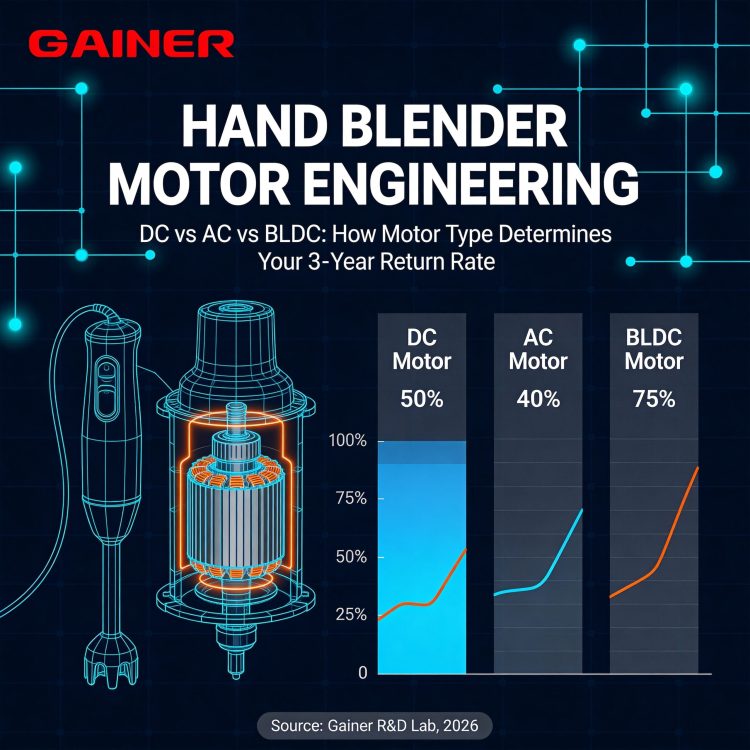
DC motors use permanent magnets and electronic commutation to deliver near-constant torque across their entire RPM range. A 500 W DC motor can match or exceed the bread-dough kneading performance of an 800 W AC motor, because the DC motor does not lose torque as speed decreases. DC motors also run cooler and quieter: a DC motor under bread-dough load typically operates at approximately 45 dB, compared to 70–80 dB for an AC motor under the same load — the difference between a library and a vacuum cleaner (Hauswirt).
For a B2B buyer, the specification to request is not wattage but torque at the beater at the lowest speed setting, measured in Newton-metres. A manufacturer that can provide this figure — and the test protocol used to obtain it — is demonstrating genuine engineering capability rather than marketing a wattage number.
—
What This Means for Your Sourcing Decision
Selecting a stand mixer OEM partner is ultimately an exercise in failure-mode analysis. Every engineering choice in the planetary gear train — tooth profile, ring gear material, planet count, lubricant specification, motor type, and drive architecture — maps to a specific failure mode, and every failure mode maps to a warranty cost.
A manufacturer that specifies involute gears with tip relief, a 20CrMnTi carburised ring gear, NSF H1-certified EP grease, and a DC direct-drive motor has made engineering choices that minimise the probability of gearbox failure across the product’s design life. These choices cost more at the bill-of-materials level but reduce the warranty reserve — and protect the brand from the downstream cost of consumer returns.
Shenzhen Gainer Electrical Appliances Co., Ltd. operates six production lines across a 9,000 m² facility in Shenzhen’s Guangming District, with a monthly output capacity of 250,000 units and 13 years of OEM/ODM experience serving European, Middle Eastern, and North American markets (Gainer). The factory holds BSCI, ISO9001, GS, CE, CB, ROHS, REACH, LFGB, FDA, and SAA certifications, and maintains a defect rate below 1% through in-house life-testing, function-testing, and safety-testing laboratories (Gainer). An R&D team of ten engineers launches approximately 40 new products annually, with each product protected by design and technical patents (Gainer).
For B2B buyers evaluating stand mixer OEM partnerships, the relevant audit question is not whether the factory can produce a mixer that spins — it is whether the factory can articulate, with evidence, the engineering rationale behind the planetary gear train’s tooth profile, material specification, and lubrication protocol. Those three decisions determine the warranty cost curve far more than the colour of the housing or the number of speed settings on the control knob.
Related Engineering Resources
- Kitchen Appliance Packaging Engineering — How Your Box Design Affects Shipping Cost, Damage Rate, and Amazon FBA Fees — How box design affects shipping cost, damage rate, and Amazon FBA fees
- Quality Control in Kitchen Appliance Manufacturing: Beyond AQL 2.5 — Quality control beyond AQL 2.5 in kitchen appliance manufacturing
- European Brand OEM: What a CE GS Certified Factory in Shenzhen Really Looks Like — What a CE GS certified factory in Shenzhen really looks like for European brands