**Key Takeaways:**
– **Battery configuration** is the single most impactful engineering decision: dual-cell **7.4V/4000mAh** systems deliver **12–15 blends per charge** for soft smoothies and **6–8 blends** for ice crushing, striking the optimal balance between runtime and portability. [(InstaCuppa)](https://instacuppastore.com/blogs/main-page/portable-blender-battery-life-how-long-does-it-last-real-numbers)
– **Brushless DC motors** achieve **85–95% efficiency** with near-zero maintenance, while brushed DC motors (70–80% efficiency) remain viable for entry-level SKUs with shorter target lifespans. [(LeanMotor)](https://www.leanmotor.com/which-is-better-brushed-or-brushless-dc-motor.html)
– **Tritan copolyester** from Eastman is the safest plastic available for food-contact blending — independently verified free of estrogenic and androgenic activity and FDA-cleared for repeated use. [(Mammoth Mug)](https://mammothmug.com/blogs/hydration/tritan-vs-stainless-steel-water-bottles)
– **IP54-rated sealing** with a triple-layer silicone gasket system is the engineering minimum for a leak-proof portable blender that can survive daily commutes and gym bags. [(TÜV)](https://www.tuv.com/japan/en/about-us/laboratories/global-technology-assessment-center-(gtac)/ip-testing/)
– **Shenzhen Gainer Appliances** operates **6 production lines** across a **9,000㎡ facility**, with **250,000-unit monthly capacity** and **13 international certifications** — a 13-year OEM/ODM track record for brands scaling from Amazon to retail distribution.
—
## Why Motor Engineering Determines Your Product’s Market Position
The motor is the single most expensive component in a portable blender BOM, and your choice between brushed and brushless directly shapes retail price point, warranty liability, and end-user experience. For B2B buyers, this is not a theoretical debate — it is a margin and return-rate calculation.
**Brushed DC motors** — typically the RS380 or RS390 series — are the workhorses of the sub-$20 retail portable blender segment. At **7.4V**, an RS390 motor delivers **19,000 RPM no-load speed** and **16,000 RPM under maximum efficiency load**, drawing **4.7A** and producing approximately **14.8W mechanical output** with **70.5% peak efficiency**. [(MGlory Motor)](https://www.mglorymotor.com/7-4v-dc-rs-390-motor-for-hand-portable-blender/) The trade-off is clear: carbon brushes wear predictably over 300–500 hours of cumulative runtime, which in a product used for 2–3 minutes per day translates to a functional lifespan of 3–5 years — well within most brand warranty windows.
**Brushless DC motors (BLDC)** eliminate brush wear entirely. Efficiency climbs to **85–95%**, noise drops measurably, and the motor can sustain higher RPM under load — some portable blender OEMs now ship brushless units at **26,000 RPM no-load / 20,000 RPM under load**, drawing **10–12A** at 7.4V for approximately **100W output**. [(LeanMotor)](https://www.leanmotor.com/which-is-better-brushed-or-brushless-dc-motor.html) [(Shenzhen New Trending)](https://www.alibaba.com/product-detail/Waterproof-Electric-USB-C-Rechargeable-18oz_1601425348717.html) The cost increment is roughly $2.50–$4.00 per unit at the BOM level, but the ROI materializes in reduced warranty claims and premium-tier retail positioning.
**Decision framework for B2B buyers:** If your Amazon listing targets the $19.99–$29.99 price band, a brushed RS390 motor paired with a dual-cell 7.4V battery is the standard configuration that delivers competitive performance. If you are positioning above $39.99 or targeting European markets with stricter consumer durability expectations, the brushless upgrade is a defensible differentiator.
—
## Battery Systems: The Runtime Equation Every Brand Owner Must Understand
Portable blenders universally use **18650 lithium-ion cylindrical cells**, and the configuration — single, dual, or triple — determines everything: blend count, charge time, weight, and airline travel compliance.
| Configuration | Voltage | Typical Capacity | Weight | Soft Smoothies Per Charge | Ice Crushing Per Charge |
|—|—|—|—|—|—|
| **Single Cell (1S)** | 3.7V | 2,000mAh / 7.4Wh | ~45g | 8–10 | 3–4 |
| **Dual Cell (2S)** | 7.4V | 4,000mAh / 14.8Wh | ~90g | 12–15 | 6–8 |
| **Triple Cell (3S)** | 11.1V | 6,000mAh / 22.2Wh | ~135g | 18–22 | 8–10 |
*Data: InstaCuppa real-world testing, 20-second blend cycles. [(InstaCuppa)](https://instacuppastore.com/blogs/main-page/portable-blender-battery-life-how-long-does-it-last-real-numbers)*
The **dual-cell 2S configuration (7.4V/4,000mAh)** is the market sweet spot. It provides enough voltage headroom to drive a 150W motor through ice and frozen fruit, while keeping total blender weight under 600g — a critical threshold for Amazon’s “portable” category perception. Single-cell 3.7V units struggle with anything harder than a banana-and-milk smoothie; triple-cell units add weight and cost that only a niche “heavy-duty travel” segment justifies.
**Battery degradation matters for brand reputation.** After **12–15 months** of daily use, capacity drops to **85–95%** of original; after **18–24 months**, expect **60–75%**. [(InstaCuppa)](https://instacuppastore.com/blogs/main-page/portable-blender-battery-life-how-long-does-it-last-real-numbers) Brands selling into markets with strong consumer protection laws (EU, Australia) should factor this into warranty terms. The battery is sealed and non-user-replaceable in virtually all portable blender designs — the waterproofing trade-off is industry-standard.
—
## Charging Architecture: USB-C vs. Magnetic Charging
**USB-C** has become the de facto standard for portable blender charging, and for good reason. A **4000mAh** battery charges in **2–2.5 hours** with a standard 2A phone charger, versus **6–8 hours** from a laptop USB port. [(InstaCuppa)](https://instacuppastore.com/blogs/main-page/portable-blender-battery-life-how-long-does-it-last-real-numbers) USB-C also aligns with EU common charger regulations, which mandate USB-C for portable devices sold in the European market.
**Magnetic charging** offers a differentiated user experience: snap-on alignment with audible click feedback, recessed contacts that resist corrosion, and typically 2-hour charge times for dual-cell configurations. [(HongFeng Precision)](https://www.cnhfprecision.com/products/portable-mini-juicer-cup-blender-manufacturer.html) The trade-off is a proprietary cable that users must not lose, and a slightly higher BOM cost. Magnetic charging tends to perform better in markets where the blender is sold as a lifestyle accessory rather than a utilitarian kitchen tool.
**Recommendation:** For Amazon FBA and broad retail distribution, USB-C is the safer, regulation-proof choice. For DTC brands with controlled accessory ecosystems, magnetic charging creates a premium tactile experience that justifies a higher price point.
—
## Cup Material Engineering: Tritan, Borosilicate Glass, and 304 Stainless Steel
The material that holds the blended beverage is both a safety certification requirement and a brand positioning lever. Each material carries distinct engineering trade-offs.
| Property | **Tritan Copolyester** | **Borosilicate Glass** | **304 Stainless Steel** |
|—|—|—|—|
| **Chemical Safety** | BPA-free, EA/AA tested negative, FDA-cleared [(Mammoth Mug)](https://mammothmug.com/blogs/hydration/tritan-vs-stainless-steel-water-bottles) | Chemically inert, zero leaching | Chemically inert, zero leaching [(BZ Stainless)](https://www.bzstainless.com/304.html) |
| **Impact Resistance** | Shatter-resistant, survives 1.5m drops | Fragile — catastrophic failure on impact | Dent-resistant, near-indestructible |
| **Weight** | Lightest (~90g for 500ml) | Heavy (~350g for 500ml) | Moderate (~200g for 500ml) |
| **Optical Clarity** | 90%+ light transmission, glass-like [(Mammoth Mug)](https://mammothmug.com/blogs/hydration/tritan-vs-stainless-steel-water-bottles) | Crystal clear | Opaque |
| **Dishwasher Safety** | 1,000+ cycles without hazing | Yes, but chip risk | Yes, fully dishwasher-safe |
| **Temperature Limit** | Up to 85–100°C (cold/room temp recommended) | Unlimited (thermal shock risk) | Unlimited, suitable for all temperatures [(Mammoth Mug)](https://mammothmug.com/blogs/hydration/tritan-vs-stainless-steel-water-bottles) |
| **Recyclability** | #7 plastic — limited municipal acceptance | Infinitely recyclable | Fully recyclable through metal streams |
| **Cost (Relative)** | Mid-range | Low–Mid | Higher |
**Tritan** is the dominant material for portable blender cups in the $15–$40 retail segment. Its combination of glass-like clarity, shatter resistance, and dishwasher durability addresses the three most common consumer complaints: cracking, clouding, and safety concerns. Eastman’s testing program — which goes beyond simple BPA-absence to verify the absence of estrogenic and androgenic activity — provides a regulatory defensibility layer that generic “BPA-free” plastics cannot match. [(Mammoth Mug)](https://mammothmug.com/blogs/hydration/tritan-vs-stainless-steel-water-bottles)
**304 stainless steel** (18/8 grade: 18% chromium, 8% nickel) is the choice for brands targeting the premium or “clean material” segment. It is chemically inert — there is no leaching debate to litigate. [(BZ Stainless)](https://www.bzstainless.com/304.html) The opacity, however, is a genuine UX limitation: users cannot see blend progress, and the heavier weight pushes the total unit beyond 700g, which some consumers perceive as “not portable.”
**Borosilicate glass** is a niche option. It offers the purest taste profile and zero chemical interaction, but its fragility makes it unsuitable for the core “throw it in a gym bag” use case. It is best reserved for premium home-use SKUs where the blender rarely leaves the kitchen counter.
—
## Blade Design: Why 6 Blades Beat 4, and Why 304 Stainless Steel is the Floor
Blade geometry is not a marketing gimmick — it is the difference between a 25-second smoothie and a 40-second one with unblended chunks. **6-blade configurations** with staggered, multi-angle vortex geometry consistently outperform **4-blade flat-plane designs** in portable blender form factors. [(AliExpress France)](https://fr.aliexpress.com/s/wiki-ssr/article/Blender-portable-%C3%A0-six-lames)
The engineering principle is straightforward: a 6-blade stack creates a **cyclonic vortex** that continuously pulls ingredients from the top of the cup downward into the cutting zone. Lower blades are angled upward to lift ingredients; middle blades are serrated for pulverization; upper blades push downward, eliminating the “dome of unblended ice” that 4-blade designs leave behind. In real-world testing, 6-blade portable blenders produced **smooth, residue-free results in 25 seconds**, versus **40 seconds and occasional graininess** for 4-blade equivalents. [(AliExpress France)](https://fr.aliexpress.com/s/wiki-ssr/article/Blender-portable-%C3%A0-six-lames)
**Blade material: 304 stainless steel minimum.** The 18/8 chromium-nickel composition provides the corrosion resistance needed to survive daily exposure to acidic ingredients (citrus, berries, tomatoes) without pitting or rusting. [(BZ Stainless)](https://www.bzstainless.com/304.html) Serrated edge geometry at a **45° cutting angle** improves fibrous-ingredient processing by approximately **40%** compared to straight-edge blades. [(Alibaba)](https://www.alibaba.com/product-introduction/Factory-Supply-Portable-Glass-Blender-Blade_1600945665929.html) Hardened 304 blades can reach **52 HRC** on the Rockwell scale, sufficient for ice and frozen fruit without edge deformation. [(Jianghehai Steel)](https://www.jianghehaisteel.com/news/understanding-the-hardness-scale-for-stainless-82398143.html)
—
## Sealing Systems: IP54 as the Engineering Baseline
The most common warranty claim in portable blenders is leakage. A properly engineered sealing system is a **triple-layer defense**: a food-grade silicone O-ring gasket that forms an airtight seal between the blade housing and cup body, a threaded locking ring with mechanical compression that engages with an audible click, and a pressure equalization channel that vents trapped air post-blending to prevent lid-pop. [(AliExpress)](https://www.aliexpress.com/s/wiki-ssr/article/portable-blender-personal)
**IP54** is the minimum defensible rating for a portable blender. Per IEC 60529, this means **dust protection level 5** (limited ingress of harmful dust — no performance interference) and **water protection level 4** (splashing water from any direction — no harmful effects). [(TÜV)](https://www.tuv.com/japan/en/about-us/laboratories/global-technology-assessment-center-(gtac)/ip-testing/) This does not make the blender submersible or dishwasher-safe as a whole unit, but it does mean the motor base and electronics survive the splashes, condensation, and accidental rinses that define real-world use.
For B2B buyers: verify that your OEM’s IP54 claim is backed by an **IEC 60529 test report** from a recognized lab (TÜV, SGS, Intertek), not a self-declaration. The test protocol for IP54 involves a 10-minute dust chamber exposure and a 10-minute oscillating-tube splash test — both must be passed with no harmful internal dust accumulation and no water ingress affecting operation.
—
## Safety Design: Vacuum vs. Non-Vacuum — Understanding the Trade-off
**Vacuum blending** removes air from the blending chamber before operation, reducing residual oxygen to as low as **0.1–0.5%**. This dramatically slows oxidation: vitamin C retention can reach **91.7%** in vacuum conditions versus **63.2%** in ambient-air blending, and blended product shelf life extends **3–5×**. [(0571pack.cn)](http://www.0571pack.cn/253.html)
The engineering cost is non-trivial. A vacuum pump adds approximately $3.00–$5.00 to the BOM, requires a more complex lid assembly with a one-way valve and silicone vacuum seal, and increases the total unit weight by 50–80g. The vacuum mechanism also introduces a new failure point — pump motor burnout, valve seal degradation — that does not exist in non-vacuum designs.
**Non-vacuum portable blenders** remain the volume play. They are simpler, lighter, cheaper to manufacture, and adequate for the dominant use case: blend-and-drink-immediately. For brands entering the market at the $19.99–$29.99 price point, non-vacuum is the correct starting configuration. Vacuum becomes a meaningful differentiator at the $39.99+ tier, particularly for brands marketing to the “meal prep” and “nutrition preservation” consumer segments.
—
## Why Shenzhen Gainer Appliances: 13 Years of OEM/ODM Engineering
Shenzhen Gainer Electrical Appliances Co., Ltd. brings **13 years of OEM/ODM manufacturing experience** to every portable blender project. The factory operates **6 dedicated assembly lines** within a **9,000㎡ facility** in Longhua District, Shenzhen — the global epicenter of small appliance manufacturing. With **300 employees** and a **250,000-unit monthly capacity**, Gainer serves brand owners, Amazon FBA sellers, and importers who need reliable, certified production at scale.
The factory holds **13 international certifications**, including ISO 9001 quality management. [(Made-in-China)](https://www.made-in-china.com/showroom/sz-gainer) Every portable blender project benefits from in-house mold development, injection molding, motor integration, and finished product QC — a vertically integrated workflow that reduces lead times and eliminates the finger-pointing that plagues multi-vendor supply chains.
For B2B buyers evaluating a portable blender OEM partner, the engineering checklist is clear: verify motor type and voltage, battery cell count and brand, blade material certs, IP rating test reports, and cup material FDA/EC compliance documentation. Gainer Appliances provides full traceability on all five dimensions.
—
## Frequently Asked Questions
**Q: What is the optimal battery configuration for a portable blender targeting Amazon’s $24.99 price point?**
A: A dual-cell 2S configuration (7.4V / 4,000mAh / 14.8Wh) using two 2,000mAh 18650 cells. This delivers **12–15 soft smoothie blends** or **6–8 ice-crushing blends** per charge, with a total unit weight under 600g. [(InstaCuppa)](https://instacuppastore.com/blogs/main-page/portable-blender-battery-life-how-long-does-it-last-real-numbers) Paired with a brushed RS390 DC motor, this configuration provides the best cost-to-performance ratio for the $19.99–$29.99 retail band.
**Q: How long should a portable blender battery last before customers complain?**
A: Battery capacity remains at **100% for the first 6 months** of daily use, drops to **85–95% at 12–15 months**, and reaches **60–75% after 18–24 months**. [(InstaCuppa)](https://instacuppastore.com/blogs/main-page/portable-blender-battery-life-how-long-does-it-last-real-numbers) Brands should set warranty expectations accordingly. Weekend-only users will see 3–5 years of acceptable runtime.
**Q: Is Tritan or 304 stainless steel the safer cup material?**
A: Both are safe, but for different reasons. Tritan is independently verified free of estrogenic and androgenic activity and FDA-cleared for food contact. [(Mammoth Mug)](https://mammothmug.com/blogs/hydration/tritan-vs-stainless-steel-water-bottles) 304 stainless steel is chemically inert with zero leaching — there is literally no endocrine debate to have. [(BZ Stainless)](https://www.bzstainless.com/304.html) If your brand’s positioning is “cleanest material possible,” choose stainless. If weight and clarity matter more, Tritan is the best plastic available.
**Q: What does IP54 actually mean for a portable blender?**
A: IP54 means the blender’s motor base is protected against harmful dust ingress (level 5) and splashing water from any direction (level 4), per IEC 60529. [(TÜV)](https://www.tuv.com/japan/en/about-us/laboratories/global-technology-assessment-center-(gtac)/ip-testing/) It can survive rinsing, rain, and gym-bag condensation — but it is not submersible. Always request the IEC 60529 test report from your OEM.
**Q: How many certifications should a portable blender OEM have?**
A: At minimum: CE (EU), FCC (US), RoHS (materials), and ISO 9001 (quality management). For Amazon’s top markets, add FDA (US food contact) and LFGB (Germany food contact). Gainer Appliances holds **13 certifications** covering all major export markets.
**Q: What is the lead time for a customized portable blender from a Shenzhen OEM?**
A: Standard OEM projects with existing molds: 25–35 days for first production run. Custom mold development adds 20–30 days. Gainer Appliances’ 6-line, 250K/month capacity supports rapid scaling from pilot orders to container loads.
—
*This engineering analysis was prepared by Shenzhen Gainer Appliances, a 13-year OEM/ODM manufacturer of portable blenders and small kitchen appliances. For technical specifications, MOQ inquiries, and certification documentation, contact our engineering team.*
Related Engineering Resources
- Cordless Hand Mixer Engineering Deep Dive: A Factory-Perspective Guide for B2B Buyers — Cordless hand mixer engineering from a factory perspective for B2B buyers
- Cordless Chopper Engineering Deep Dive: What B2B Buyers Must Know Before OEM Ordering — Cordless chopper engineering deep dive: what OEM buyers must know
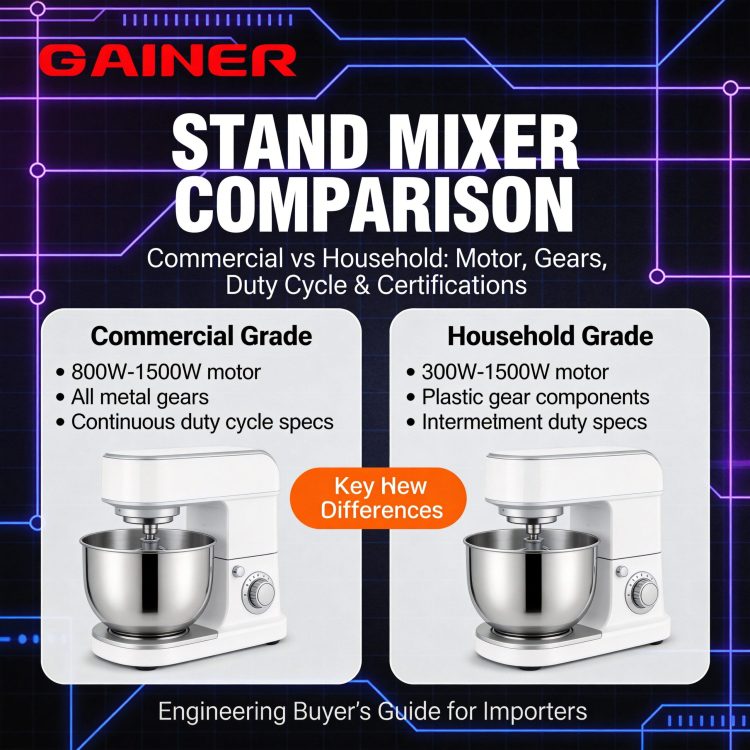
- Commercial vs. Household Stand Mixers: The Engineering Buyer’s Guide for Importers, Brand Owners & Amazon Sellers — Commercial vs household stand mixers: engineering buyer’s guide