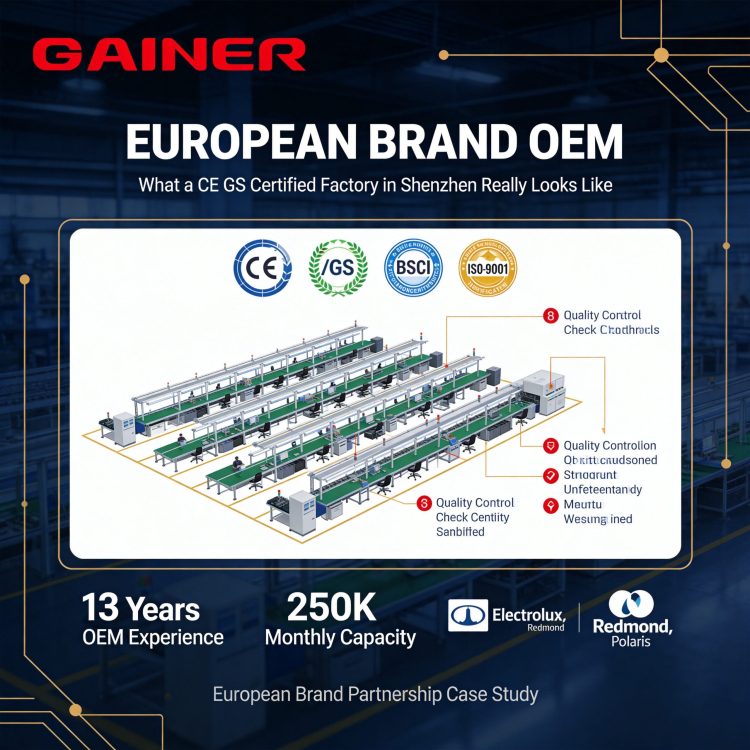
European Brand OEM: What a CE GS Certified Factory in Shenzhen Really Looks Like
Key Takeaways
- China accounts for over 70% of global small kitchen appliance manufacturing output in 2026 — European brands that bypass direct factory partnerships typically pay a 20–40% premium for the same product tier (YLD-Home).
- A CE certificate alone is no longer sufficient for European market entry. Customs authorities in Germany, France, and the Netherlands now verify underlying test data, not just the one-page certificate (APEXDURA).
- 82% of German retail buyers prioritize GS certification (Geprüfte Sicherheit) over basic CE marking for heating appliances — without it, major chains like MediaMarkt and Otto will not list your product in premium categories (APEXDURA).
- Social compliance audits — BSCI or SMETA 4-Pillar — are functionally mandatory before any European retailer issues a purchase order. A valid report is typically required within the last 12 months (Cosmo Sourcing).
- The typical procurement timeline from first factory contact to container arrival at a European port spans 60–120 days for standard OEM, with custom ODM adding 30–60 days on top (APEXDURA).
Introduction
The global kitchen appliance market is projected to grow at 6–8% annually, reaching nearly $380 billion by 2033 (YLD-Home). Behind most European-branded products is a factory in Guangdong, China. But the relationship between a European brand and a Chinese OEM factory is not a transaction — it is a partnership built on a compliance portfolio that takes years to assemble.
Gainer Appliances (Shenzhen Gainer), founded in 2013 with 6 production lines, 9,000 m² of manufacturing space, 300 employees, and a monthly capacity of 250,000 units, has spent over a decade learning what European brands actually require — and what they rarely say out loud.
The Compliance Stack: What European Brands Actually Need
European retail buyers do not shortlist suppliers. They shortlist compliance portfolios (APEXDURA). A German retail chain reviews documentation before product. An Austrian distributor confirms importer registration before accepting samples. Here is what that documentation stack looks like.
CE Marking — The Non-Negotiable Baseline
In 2026, a CE certificate is no longer enough. Customs authorities and market surveillance bodies — including Germany’s Federal Network Agency — have shifted from checking paper to verifying underlying test data (APEXDURA).
The mandatory directives:
- LVD 2014/35/EU: Electrical safety, with mandatory EN IEC 60335-1:2025 standards. If a factory is still referencing the 2012 or 2016 versions, the product is legally non-compliant even with a CE mark printed on it (APEXDURA).
- EMC 2014/30/EU: Electromagnetic compatibility. EMC filters are often the first component a low-cost supplier removes to save $0.50 per unit (APEXDURA).
- ErP 2009/125/EC: Standby power consumption must be ≤0.5W under Regulation 2023/826, tightening to ≤0.3W from January 2027 (APEXDURA).
- RED 2014/53/EU: For smart/Wi-Fi appliances, cybersecurity Annex U requirements apply (APEXDURA).
One critical lesson from 13 years of manufacturing: always request the full test report (typically 50–100 pages), not just the one-page certificate. Factories that cannot provide this within five business days are signaling how they manage documentation under production pressure (APEXDURA).
GS Certification — The German Market’s Commercial Gatekeeper
The GS Mark (Geprüfte Sicherheit) is a voluntary certification issued by state-authorized bodies such as TÜV Rheinland, TÜV SÜD, and VDE (TÜV SÜD). While not legally mandatory, it is commercially essential: 82% of German retail buyers prioritize GS over basic CE for heating appliances (APEXDURA). CE allows self-declaration for some categories; GS requires mandatory annual factory audits. GS testing enforces stricter PAH limits under AFPS GS 2019:01 beyond REACH/RoHS (APEXDURA). Products bearing the GS Mark command a 15–25% price premium in Germany (Huayutest).
LFGB, RoHS, REACH, and WEEE — The Full Compliance Portfolio
For kitchen appliances with food-contact surfaces, compliance extends far beyond CE:
- LFGB §30/31: A blender with a plastic jug, rubber gasket, stainless steel blade, and coated base requires four separate material declarations (APEXDURA). On July 3, 2026, a Chinese kitchenware set was recalled from 16 EU countries after aluminum migration tested at 132 mg/kg — over 25 times the 5 mg/kg limit under EU 1935/2004 (APEXDURA).
- RoHS: 10 restricted substances — mandatory for all EU markets.
- REACH: SVHC list updated biannually. Food-grade plastics and non-stick coatings face expanding PFAS restrictions (APEXDURA).
- WEEE: Each EU member state requires separate producer registration for waste equipment take-back.
Gainer Appliances holds 9 core certifications covering this full stack, with third-party test reports from accredited laboratories — not self-declarations.
Beyond Paperwork: Social Compliance Audits
European retailers treat social compliance as a precondition for commercial engagement. BSCI (amfori) is the default framework for European buyers, with over 2,600 member companies including Lidl, Aldi, Carrefour, and H&M (CRSTS). BSCI grades range from A (outstanding) to E (unacceptable): A/B are valid for 2 years, C requires follow-up within 12 months (CRSTS).
SMETA (Sedex) comes in two versions: 2-Pillar (labor + health/safety) and 4-Pillar (adds environment and business ethics). The 4-Pillar audit is increasingly required by premium European brands, running 2–5 days on-site at $2,500–$4,000 (Cosmo Sourcing).
The regulatory backdrop is tightening. Germany’s Supply Chain Act (LkSG) — effective since January 2023 — covers companies with 1,000+ employees, a lower threshold than the amended EU CSDDD (Continuuiti). In practice, large in-scope buyers push due diligence expectations down through contracts regardless of the directive’s scope.
Product Design Requirements for the European Market
Energy Labels and ErP Directive
The ErP framework governs three operational states: off-mode, standby, and networked standby. Since May 9, 2025, standby power must not exceed 0.5W. From January 1, 2027, Phase II tightens off-mode to 0.3W — a further 40% reduction (APEXDURA). German, French, Dutch, and Italian market surveillance authorities have prioritized air fryers and coffee makers for ErP spot-checks in 2026 (APEXDURA). Gainer pre-validates power management ICs against the 2027 threshold during the engineering phase — a step that saves an estimated €8,000–€25,000 in rework per model (APEXDURA).
Repairability and the Right to Repair
France has mandated a publicly displayed repairability score (0–10) on electrical appliances since January 2021, covering dishwashers, vacuum cleaners, and other categories, calculated across five criteria: documentation, disassembly, spare parts availability, pricing, and product-specific factors (French Ministry of Economy). At the EU level, the Right to Repair Directive (2024/1799/EU) becomes national law by July 31, 2026, requiring manufacturers to make spare parts available to independent repairers at fair prices (RepairScore). The ESPR adds a Digital Product Passport — a machine-readable record via QR code with material composition and repairability scores. The EU DPP Registry went live on July 19, 2026 (APEXDURA).
Cooperation Models: OEM, ODM, and Private Label
European brands working with Chinese factories typically operate under one of three models:
- OEM: The brand provides the full design specification. The factory manufactures to that spec. Maximum control, requires in-house engineering capability.
- ODM: The factory offers existing product platforms the brand can customize — color, branding, packaging, and minor features. The fastest route to market for brands without R&D.
- Private Label: The brand selects a factory’s existing model and applies its own branding. MOQs start at 500–1,000 units, with trial orders of 50–100 units at a 10–15% unit price premium (APEXDURA).
Gainer Appliances operates across all three models, with 13 years of experience serving European brands across the DACH region, Eastern Europe, and the Nordics.
The Real Procurement Timeline
A kitchen appliance order from a Chinese factory follows a predictable timeline. From PO confirmation to production complete takes 30–45 days. Sea freight from South China to Northern Europe takes 45–55 days door-to-door, with the Cape of Good Hope routing — now standard due to Red Sea disruption — adding 10–14 days (APEXDURA).
The full private label launch spans five stages: RFQ and factory selection (Weeks 1–4), sample development (Weeks 5–10), certification (Weeks 8–16), mass production (Weeks 16–22), and shipment (Weeks 22–26) (APEXDURA). Buyers who do not account for this 60–120 day window routinely miss their retail launch target by one full quarter.
The Unspoken Challenges
Cultural Communication Gaps
The phrase “没问题” (méi wèn tí) — literally “no problem” — is the most expensive two words in China-Europe sourcing. It often means “I heard you” or “I will look into it,” not a firm commitment (Tendify). Silence, similarly, does not signal agreement — it often means internal discussions are ongoing (Tendify). The solution: every non-standard specification must be confirmed in writing, and every verbal agreement followed by a written summary with an explicit confirmation request.
Quality Control and Dispute Resolution
The most common quality failure in private label kitchen appliances is the copper-to-aluminum motor switch. A factory substitutes aluminum winding for copper after sample approval. The product looks identical but fails in field use within 6–18 months (APEXDURA). Prevention requires specifying motor winding material in the purchase order and conducting a mid-production inspection (DUPRO) at approximately 20% completion — when the factory can still rework the batch (MAXAM Group).
A professional third-party inspection in China costs €250–400 per day. A defect found at the right time is a quality event. The same defect found at the wrong time is a supply chain crisis (MAXAM Group).
After-Sales and Warranty
European consumer protection laws require a minimum 2-year legal guarantee. The economics of warranty logistics for kitchen appliances are unforgiving: a product with an FOB cost of $18 can cost $12–15 to return domestically within Europe — the defect rate hits your margin directly (SourcifyChina). Gainer Appliances recommends a 12-month factory warranty as standard, with the option to negotiate 18 months on first orders.
What Gainer Appliances Brings to the Table
Shenzhen Gainer Appliances was founded in 2013 and has spent over a decade building the compliance infrastructure European brands require. The factory operates 6 production lines across 9,000 m², with 300 employees and a monthly output of 250,000 units. The facility holds 9 core certifications covering CE, GS, RoHS, REACH, LFGB, and WEEE — all validated by accredited third-party laboratories.
Gainer’s approach is built on three principles: (1) full test reports provided at the RFQ stage, not just certificates; (2) a dedicated project manager assigned from sample to shipment; and (3) compliance documentation maintained proactively — so when a German retail buyer’s procurement team requests the LFGB migration test report, it is already in the shared folder.
Frequently Asked Questions
Is CE certification enough to sell kitchen appliances in Germany?
No. While CE is the legal minimum, German retail chains require GS certification for heating appliances — 82% of German retail buyers prioritize GS over basic CE (APEXDURA). Food-contact appliances additionally require LFGB §31 testing for the DACH market.
What is the difference between BSCI and SMETA audits?
BSCI (amfori) is the default for European retailers, producing a graded report (A–E). SMETA (Sedex) is more common for UK buyers. The 4-Pillar SMETA adds environmental assessment and business ethics to the labor and safety baseline. Most European buyers accept either (Cosmo Sourcing).
How long from factory selection to first shipment?
60–120 days for standard OEM. Custom ODM adds 30–60 days. Sea freight adds 45–55 days door-to-door (APEXDURA). Budget 14–16 weeks total from PO to retail shelf.
What is the minimum order quantity for private label?
500–1,000 units for branded existing models. Trial orders of 50–100 units at a 10–15% unit price premium (APEXDURA).
How do I verify a factory’s certifications are genuine?
Request the full test report (50–100 pages), not just the certificate. Verify the lab on the EU NANDO database (CE) or TÜV Certipedia (GS). Cross-reference the certificate number with the issuing body. A factory that cannot provide third-party test reports within five business days is signaling a documentation gap (APEXDURA).
Conclusion
The European kitchen appliance market rewards brands that treat compliance as a competitive advantage, not a cost center. For European brand owners evaluating Chinese manufacturing partners, the question is not “Can you make this product?” It is “Can you provide the full test reports, the social compliance audit, the material migration data, and the spare parts availability commitment — today, not in three months?” The answer separates a factory from a partner.
This article was written from the factory-floor perspective of Gainer Appliances (Shenzhen Gainer) — 13 years of OEM/ODM experience, 6 production lines, 9,000 m² facility, 300 employees, 250,000-unit monthly capacity, and 9 core certifications serving European brands.
Related Engineering Resources
- Kitchen Appliance Packaging Engineering — How Your Box Design Affects Shipping Cost, Damage Rate, and Amazon FBA Fees — How box design affects shipping cost, damage rate, and Amazon FBA fees
- Quality Control in Kitchen Appliance Manufacturing: Beyond AQL 2.5 — Quality control beyond AQL 2.5 in kitchen appliance manufacturing
- Stand Mixer Planetary Gear Engineering: The Real Difference Between 15° and 18° Helix Angles — Planetary gear engineering: 15° vs 18° helix angles in stand mixers