How to Choose a Chinese Small Appliance OEM Factory: The 5-Step Verification Method
Key Takeaways:
- China exported $111.41 billion in home appliances in 2025, making it the world’s dominant manufacturing hub for small kitchen appliances (CHEAA).
- 85% of quality defects are discovered during factory audits or pre-shipment inspections — not after goods arrive at your warehouse (Alibaba Trade Index 2025).
- A single factory audit costs $500–$1,200 — a fraction of what a single rejected container costs your business (Industry benchmarks).
- Professional factories that welcome audits maintain documented CAPA systems, transparent client references, and verifiable certification records — if a factory resists scrutiny, walk away.
Introduction
The global kitchen small electronic appliances market reached $79.7 billion in 2024 and is projected to grow to $124.3 billion by 2034, at a compound annual growth rate of 4.5% (Global Market Insights). China manufactures approximately 32.7% of the world’s small kitchen appliances, supported by a home appliance industry that generated RMB 1.97 trillion in operating revenue in 2025 (National Bureau of Statistics).
Yet for every brand owner, importer, or Amazon seller sourcing from China, the same question arises: how do you tell a legitimate, capable OEM factory from a trading company with a rented showroom? According to China Customs data, factory audit failures caused $2.8 billion in rejected shipments to Latin America alone in 2025, primarily from suppliers misrepresenting their production capacity or using unverified subcontractors (China Customs 2026).
This guide, drawn from 13 years of OEM/ODM manufacturing experience at Shenzhen Gainer Appliances, presents a practical 5-step verification framework that any B2B buyer can apply before committing to a production order. Each step includes specific operational instructions and the red flags that signal you should walk away.
!5-Step OEM Factory Verification Framework
Step 1: Credential Verification — Don’t Trust a PDF
The first step is the easiest to execute and the most frequently skipped. A factory’s certificates mean nothing until you verify them independently through the issuing authority’s official database.
What to Verify
Business License. Request the factory’s unified social credit code (统一社会信用代码) and verify it on China’s National Enterprise Credit Information Publicity System (GSXT). Confirm that the registered legal name, address, and scope of business match exactly what appears on the supplier’s quotation and website. A mismatch between the registered address and the actual factory location is one of the most common signals that you are dealing with a trading intermediary rather than a manufacturer (Goodcan Trading).
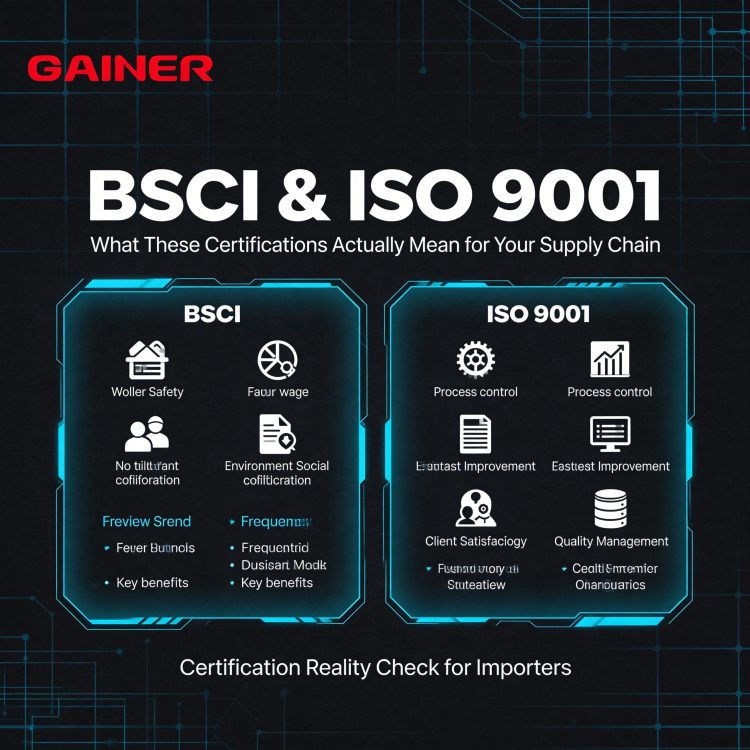
ISO 9001 Certification. Request the certificate number and the accreditation body’s name. Then verify the certification body on the International Accreditation Forum (IAF) member database at iaf.nu. Fake ISO certificates are widely circulated in Chinese manufacturing hubs — if the issuing body is not on the IAF list, the certificate is invalid (IAF CertSearch).
amfori BSCI Audit. For social compliance, the BSCI audit is the most widely recognized standard in European and global retail. Every factory registered in the amfori system receives a unique Database Identification Number (DBID). Ask the supplier for their DBID, then verify through the amfori Sustainability Platform that the audit is active and the grade is acceptable. A Grade A or B audit is valid for 2 years; Grade C requires a follow-up within 1 year; Grade D or E means the factory failed and should not be considered (amfori BSCI). Over 40,000 BSCI audits are conducted annually across 120+ countries, and the amfori platform is the only authoritative source for verification (amfori via Consumer Goods Forum).
Red Flags
- The certificate shows a different company name than the one on your contract.
- The factory cannot provide a DBID or the certificate number does not return a match on the official platform.
- The audit was conducted at a different address than the factory where your production will take place — a classic “show factory” tactic.
- The certificate is within its validity window but the factory refuses to share the full audit report PDF.
Step 2: On-Site Factory Audit — See It Before You Sign It
A factory audit is the single most important due-diligence step before placing a production order. 67% of EU importers now mandate third-party factory audits for Chinese suppliers (CCPIT 2025). Professional audits cost between $500 and $1,200 per day, depending on the agency and scope (Industry benchmarks).
What to Audit: The 7-Pillar Framework
Effective audits in 2026 evaluate suppliers across seven interconnected pillars (Qianshiwear):
- Legal & Business Legitimacy — licenses, ownership structure, and confirmation that the factory is not a shell company.
- Quality Management System (QMS) — documented processes, Corrective Action / Preventive Action (CAPA) records, and incoming quality control (IQC) logs.
- Production Capacity & Capability — physically count production lines and verify actual output against claims. A factory claiming 50,000-unit monthly capacity should have at least 80–120 workers on the floor during peak hours.
- Equipment & Test Instruments — check calibration status, maintenance logs, and whether the factory has in-house testing laboratories.
- Raw Material Handling & Incoming QC — verify supplier lists, material inspection records, and storage conditions.
- Workforce Training & Quality Culture — review training records, observe worker-to-supervisor ratios (professional factories maintain 1 supervisor per 15–20 workers), and conduct private worker interviews away from management.
- Social Compliance — working hours, wages, fire safety, and emergency exit accessibility. Locked fire exits during shift hours are an instant disqualification.
On-Site Walkthrough Checklist
Walk the production floor during working hours — not during lunch breaks or weekends when operations stop. Pay attention to:
- Production line condition: Are machines well-maintained, or do you see oil leaks, rust, and missing safety guards?
- QC checkpoints: Professional factories place visible quality checkpoints every 3–5 workstations.
- Worker demeanor: Do employees appear engaged and knowledgeable, or are they avoiding eye contact with management present?
- Sample storage: Are old customer samples visible and unprotected? If so, ask how your proprietary designs will be stored and secured.
Red Flags
- The factory offers a staged tour that avoids specific production areas or raw material storage.
- Equipment calibration records are expired or missing entirely.
- Training records are older than 12 months or cover fewer than 80% of relevant staff.
- The factory cannot produce incoming material inspection records or a supplier list.
- Quality personnel are incentivized purely by output volume rather than quality metrics.
Step 3: Sample Testing — The Proof Is in the Product
Certificates and clean factory floors are table stakes. The real test of an OEM partner is whether they can execute your specification. A sample order is the cheapest insurance you will ever buy — the cost of 5 sample sets, typically $50–200 plus freight, is trivial compared to discovering that a 1,000-unit container is dimensionally off (Partzeal).
Sample Testing Protocol
Request 3–5 units of your primary SKU. This gives you enough units for:
- 1 unit for destructive testing — open it up, examine internal components, check soldering quality, verify material grades and thicknesses.
- 2–3 units for functional testing — run the appliance through its full operating cycle, test all modes, measure power consumption, and verify temperature controls.
- 1 unit as a retained reference sample — sign it, seal it, and keep it as the benchmark against which future production will be measured.
What to Test
- Functional performance: Does the appliance perform as specified? Test every function, every setting, every mode. Measure actual output against the specification sheet.
- Durability testing: Run the appliance continuously for the equivalent of its claimed lifespan. For a blender, that means hundreds of blending cycles; for a coffee maker, hundreds of brew cycles. Document any failures.
- Safety verification: Check for electrical safety (grounding, insulation), thermal safety (overheating protection), and mechanical safety (blade guards, non-slip feet). Request the factory’s IEC 60335 electrical safety test reports from accredited labs such as SGS, Intertek, or TÜV.
- Teardown comparison: Open one sample and compare every internal component against the bill of materials (BOM). Check the motor brand, the PCB quality, the wiring gauge, and the housing material. A factory that substitutes a cheaper motor or thinner wiring inside the housing is a factory that will cut corners in production.
Red Flags
- Dimensional variance exceeding 2% on any critical measurement (Partzeal).
- Material substitution detected by weight, hardness, or visual inspection — a sample that is 200g lighter than the specification is using different materials.
- Inconsistency across the 5 samples — this signals a quality control failure or a mixed-batch shipment.
- The supplier deflects on follow-up questions with responses like “it will be fine in bulk production” — they know there is a problem.
Step 4: Client Reference Check — Talk to the People Who Already Paid
A factory’s existing clients are the most honest source of information you will ever have. A professional factory that delivers quality work will be proud to connect you with references. A factory that has something to hide will deflect.
How to Conduct a Reference Check
Request a client list. Ask the factory for 3–5 client references who have placed orders similar in scale and product category to what you are planning. Ask for clients from your target market — a factory that has never exported to the EU will not understand REACH compliance requirements, and a factory that has never shipped to the US will not be familiar with UL standards.
Contact the references directly. Do not rely on written testimonials that the factory provides. Call or email the reference. Ask specific questions: “How did the factory handle a quality issue on your order?” “Were there any delays, and how were they communicated?” “Would you use them again for your next product launch?”
Review cooperation case studies. Ask the factory to show you photos and documentation from completed projects — not marketing materials, but actual production records, shipping documents, and quality inspection reports from previous orders. A factory that can show you a documented history of on-time deliveries and passed inspections is a factory that takes its track record seriously.
Red Flags
- The factory refuses to provide references or claims “client confidentiality” as a blanket excuse.
- All provided references are from the same country or the same type of buyer — this may indicate a curated, non-representative list.
- The references are unreachable, respond with generic praise, or seem scripted.
- The factory cannot produce any documentation from past projects — no photos, no inspection reports, no shipping records.
Step 5: Small-Batch Trial Production — Test the Real Delivery Capability
A factory can pass an audit, deliver perfect samples, and present glowing references — and still fail when it comes to consistent production at scale. The final verification step is a small-batch trial order of 100–500 units. This is not a token order; it is a stress test of the factory’s actual production system.
What to Evaluate During the Trial
Delivery timeline accuracy. Does the factory deliver on the date it promised? A delay of more than 3–5 business days without proactive communication is a warning sign. During the 2025 period, China’s home appliance exports reached $111.41 billion (CHEAA), and factories with strong order books manage their production schedules tightly — delays are a management failure, not a capacity constraint.
Quality consistency across units. Pull a random sample of 5–10% of the trial batch and inspect every unit against the same criteria you used for the pre-production samples. If the quality varies noticeably between units, the factory’s process control is inadequate for larger orders.
Communication responsiveness. How quickly does the factory respond to questions during production? Do they proactively share production updates, photos of materials arriving, and first-off-the-line quality checks? A factory that goes silent between the deposit and the shipping notice is a risk, not a partner.
Packaging and labeling accuracy. Verify that every unit is correctly packaged, labeled, and barcoded according to your specifications. Packaging errors discovered after the goods arrive in your warehouse are expensive to correct and can delay your Amazon FBA inbound shipments.
Red Flags
- The trial order misses the promised delivery date by more than a week.
- Quality varies significantly between units within the same batch — a clear sign of inadequate in-process quality control (IPQC).
- The factory is unresponsive or evasive when you request production updates or photos.
- The factory uses the trial order to test a new subcontractor without informing you.
Red Flags vs. Green Flags: Quick Reference
| Verification Step | 🚩 Red Flag | ✅ Green Flag |
|—|—|—|
| Step 1: Credentials | Certificate name ≠ contract name; cannot verify on IAF/amfori | All certifications verified on official registries with matching entity names |
| Step 2: Factory Audit | Staged tour; hidden areas; expired calibration records | Full access to all production areas; documented QC records; trained staff |
| Step 3: Samples | >2% dimensional variance; material substitution; inconsistency across units | All units within spec; full documentation provided; supplier responsive to feedback |
| Step 4: References | Refuses to share; “friendly” contacts only; no project documentation | Proactively shares diverse references; references offer specific, detailed feedback |
| Step 5: Trial Order | Missed deadlines; inconsistent quality; poor communication | On-time delivery; consistent quality; proactive updates throughout production |
What a Factory That Welcomes Audits Looks Like
At Shenzhen Gainer Appliances, we have been manufacturing small kitchen appliances since 2013 — 13 years of OEM and ODM production for brand owners, importers, and e-commerce sellers across 30+ countries. Our facility spans 9,000 square meters with 6 production lines, 300 employees, and a monthly production capacity of 250,000 units. We hold 9 core certifications including ISO 9001, BSCI, and product-specific certifications for CE, RoHS, and REACH compliance.
A professional factory treats audits as an opportunity, not an inconvenience. We maintain documented IQC, IPQC, and OQC records. We provide client references from buyers in North America, Europe, the Middle East, and Southeast Asia. We welcome third-party audits from SGS, Bureau Veritas, TÜV, and Intertek. And we have never missed a shipment deadline that was within our confirmed capacity.
The factories worth partnering with are the ones that can say the same.
Frequently Asked Questions
How much does a factory audit in China cost?
A professional third-party factory audit in China costs between $500 and $1,200 per day, depending on the agency (SGS, Bureau Veritas, TÜV, Intertek) and the scope of the audit (Industry benchmarks). For orders above $10,000, the audit cost represents less than 5% of the order value — a fraction of the cost of a single rejected shipment.
Can I rely on ISO certificates instead of doing a full audit?
No. ISO certificates show that a quality management system exists on paper. An on-site audit verifies that the system is actually implemented, effective, and maintained on the production floor. Fake ISO certificates circulate widely in Chinese manufacturing hubs (Goodcan Trading). Always verify the certificate through the IAF database and confirm through a physical audit.
What is the difference between BSCI Grade A and Grade C?
A BSCI Grade A or B audit means the factory demonstrates high compliance with the amfori BSCI Code of Conduct, with very few minor non-compliances. It is valid for 2 years. A Grade C means the factory meets minimum standards but has several moderate non-compliances requiring a corrective action plan. It is valid for 1 year. Grade D or E means the factory failed and should not be considered (amfori BSCI).
What is a reasonable MOQ for a first trial order?
Most established Chinese small appliance OEM factories have an MOQ of 500–2,000 units per SKU for mass production. However, a trial order of 100–500 units is typically negotiable for first-time buyers who demonstrate serious intent. Factories that refuse any trial order below their stated MOQ may be inflexible partners for growing brands.
How long does the full 5-step verification process take?
A realistic timeline: credential verification takes 1–2 days (online checks); factory audit takes 1–2 days on-site plus 3–5 days for the audit report; sample testing takes 2–4 weeks depending on shipping and testing scope; reference checks take 3–5 days; and a trial production run typically takes 4–8 weeks from PO to delivery. In total, expect 8–14 weeks for a thorough verification before committing to a full production order.
Conclusion
Choosing a Chinese OEM factory for small kitchen appliances is not about finding the lowest price — it is about finding a manufacturing partner that can deliver consistent quality, on time, and with transparent communication. The $2.8 billion in rejected shipments that China Customs recorded in 2025 is a reminder that the cost of skipping due diligence is far higher than the cost of conducting it (China Customs 2026).
Run the 5 steps — credential verification, on-site audit, sample testing, reference checks, and trial production — in sequence. Walk away at the first red flag. And when you find a factory that passes all five, you have found a partner worth building a brand with.
This guide was written by the team at Shenzhen Gainer Appliances, a small kitchen appliance OEM/ODM manufacturer with 13 years of experience, 6 production lines, and 13 international certifications. We welcome third-party audits — contact us to schedule yours.
Related Engineering Resources
- Amazon Kitchen Appliance Seller’s Sourcing Guide — How to Source Hand Blenders from Chinese OEM Factories for Amazon FBA — Amazon FBA sourcing guide for hand blenders from Chinese OEM factories
- Private Label Kitchen Appliances — The Engineering Decisions Behind Your Brand — The engineering decisions behind your private label kitchen appliance brand
- MOQ in Kitchen Appliance Manufacturing — What 1,000 Pieces Really Means — What 1,000-piece MOQ really means in kitchen appliance manufacturing
- Private Label Hand Blenders for Amazon FBA: The Real Cost Breakdown from a Shenzhen Factory Floor — Real FBA cost breakdown from a Shenzhen factory floor for private label hand blenders