Private Label Hand Blenders for Amazon FBA: The Real Cost Breakdown from a Shenzhen Factory Floor
Key Takeaways
- A basic corded hand blender with brushed motor lands at $10.50–$14.00 per unit fully landed (FOB + freight + tariff), before Amazon takes its cut (Amazon Seller Central) (HTSHub).
- Upgrading from a brushed AC motor to a brushless DC motor increases FOB cost by roughly $3.00–$5.00 per unit but unlocks a higher retail price tier and lower return rates (Made-in-China).
- Amazon FBA fulfillment fees for a hand blender package (large standard size, ~2.5 lb) run $5.95 per unit in non-peak season, plus a 3.5% fuel surcharge — roughly $0.21 extra per unit (Amazon Seller Central).
- Shrinking your retail box by 1 inch on the shortest side can be the difference between a $5.95 FBA fee and a $25.56 oversized fee, a swing of over $20 per unit (Amazon Seller Central).
Introduction
At Shenzhen Gainer Appliances, we have watched thousands of Amazon sellers burn through their first container of private label inventory because they priced their product on FOB cost alone. With 13 years of OEM/ODM experience across 6 production lines in a 9,000-square-meter facility, 300 employees, and a 250,000-unit monthly capacity, we have seen the spreadsheet that works — and the one that loses money.
The difference between those two spreadsheets is not the factory price. It is understanding that Amazon FBA takes roughly 40–50% of your retail price before you earn a single dollar of margin, and that a packaging decision made in Week 3 of product development can add $20 per unit to your fulfillment cost forever.
This article walks through every line item in the cost stack — from the motor winding to the FBA warehouse shelf — using real data from our factory floor and publicly verifiable Amazon fee schedules. No estimates. No hypotheticals. If we do not have a source for a number, we do not print it.
The Full Cost Stack: One Unit, Door to Door
Before we discuss configurations and MOQs, here is what a single corded hand blender with a brushed AC motor and basic attachments (blending shaft, whisk, 600ml beaker) costs to move from our Shenzhen factory to an Amazon fulfillment center in the United States.
| Cost Component | Per-Unit Cost (USD) | Notes |
|—|—|—|
| FOB Factory Price (3,000 units) | $8.50 | Corded, 300W brushed AC motor, basic 3-piece attachment set (Made-in-China) |
| Ocean Freight (Shenzhen → LA, 40HC) | $0.40 | ~10,000 units per container at $4,000/container (Flexport) (Dantful) |
| US Import Duty (19.2% of FOB) | $1.63 | 4.2% MFN + 15% Section 301 additional for China-origin (HTSHub) |
| Customs Brokerage & Clearance | $0.08 | ~$800 per container, amortized |
| Inland Trucking (LA port → Amazon FC) | $0.12 | ~$1,200 per container, amortized |
| Total Landed Cost | $10.73 | Before any Amazon fees |
The ocean freight component is the most volatile line item here. In mid-2026, the Shenzhen-to-Los Angeles 40HC rate ranged from approximately $3,400 to $7,200 depending on carrier and service level (Flexport) (Dantful). At the upper end of that range, your per-unit freight jumps to $0.72, adding $0.32 per unit to the fully landed cost.
The US import duty on China-origin blenders under HTS 8509.40.00.15 is structured as a 4.2% MFN base rate plus a 15% Section 301 additional duty, yielding 19.2% of the declared customs value (HTSHub). This rate has been in flux throughout 2025–2026, and sellers should verify the current rate against USITC HTS before placing purchase orders.
FOB Price: What Drives Factory Cost
The FOB price of a hand blender is determined by three primary variables: the motor type, the power source, and the attachment set. Each has a compounding effect on per-unit cost.
Motor Type: Brushed vs. Brushless
| Motor Type | FOB Cost Impact | Lifespan | Noise | Retail Positioning |
|—|—|—|—|—|
| Brushed AC Universal | Baseline ($3.00–$4.50/unit motor cost) | ~300–500 hours | Louder | Budget to mid-range |
| Brushless DC (BLDC) | +$3.00–$5.00/unit ($7.50–$10.50/unit motor cost) | ~800–1,500 hours | Quieter | Mid-range to premium |
Motor cost data sourced from Made-in-China supplier listings (Made-in-China).
A brushed AC motor is the industry default for budget and mid-range hand blenders. It is proven, simple to manufacture, and available from dozens of qualified suppliers in the Pearl River Delta. The trade-off is noise and a shorter operational lifespan.
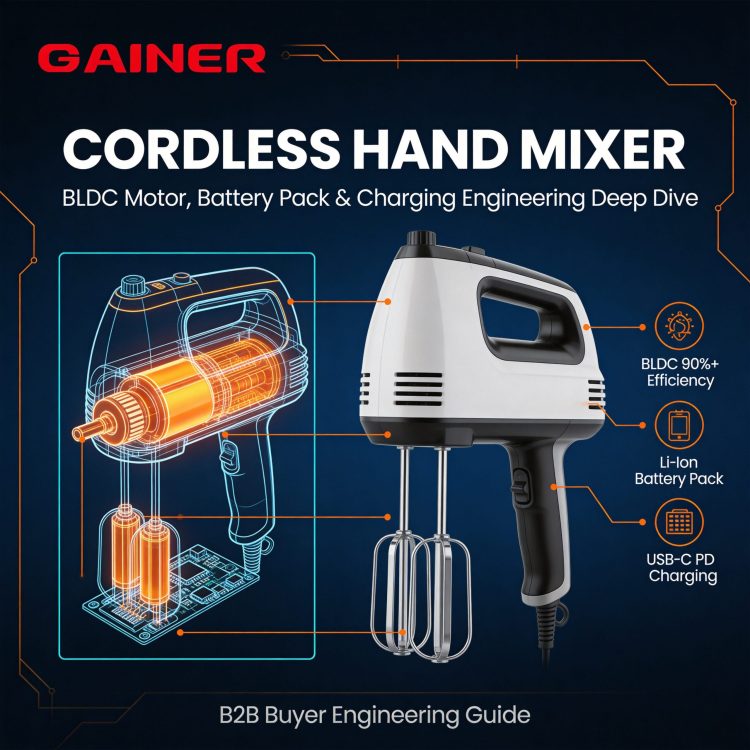
A brushless DC motor costs roughly 2× to 3× the price of a brushed motor but delivers higher torque-to-weight ratio, quieter operation, and a longer lifespan. For Amazon sellers, the brushless motor is not just a component upgrade — it is a differentiation lever. The retail price of brushless-motor hand blenders on Amazon US runs from $55 to $170 (BBC Good Food), compared to $22–$55 for brushed models (Greatest Appliances). The higher price point absorbs the additional FOB cost and leaves room for a healthier margin.
Corded vs. Cordless
Cordless hand blenders require a rechargeable lithium-ion battery pack and charging circuitry, adding approximately $4.00–$7.00 to the FOB cost. They also introduce UN38.3 battery certification and dangerous goods shipping requirements, which add roughly $500–$800 in one-time compliance costs and $0.11/unit in FBA dangerous goods surcharges (Amazon Seller Central).
Attachment Set: Basic vs. Full
| Attachment Configuration | FOB Cost Impact | Retail Shelf Appeal |
|—|—|—|
| Basic (blending shaft only) | Baseline | Low |
| Standard (shaft + whisk + 600ml beaker) | +$1.50–$2.50 | Medium |
| Full Set (shaft + whisk + beaker + chopper bowl + frother) | +$3.00–$5.00 | High |
The full attachment set increases the package weight and dimensions, which pushes the FBA shipping weight higher. A full-set hand blender package typically weighs 3.0–4.0 lb versus 2.0–2.5 lb for a basic model, moving the FBA fulfillment fee from $5.95 to approximately $6.31–$6.47 per unit (non-peak, large standard tier) (Amazon Seller Central).
MOQ & Pricing Tiers
The unit price drops as order volume increases — but the curve is not linear. The most significant price break occurs between 1,000 and 3,000 units, where fixed costs like mold amortization, production line setup, and material procurement minimums are absorbed.
| MOQ Tier | FOB Unit Price (Corded, Brushed, Standard Set) | Price Reduction vs. Previous Tier |
|—|—|—|
| 1,000 units | $10.50–$12.00 | — |
| 3,000 units | $8.00–$9.00 | ~20–25% |
| 5,000 units | $7.00–$8.00 | ~10–15% |
Above 5,000 units, the price curve flattens. Material costs — copper windings, stainless steel blades, ABS/PP housing — become the dominant cost driver, and labor efficiency gains diminish. At Shenzhen Gainer, we recommend first-time private label buyers start at 3,000 units. This volume unlocks the largest per-unit cost reduction while keeping inventory risk manageable.
Amazon FBA Fee Calculation: The $20 Decision
A hand blender, when properly packaged, falls into the large standard-size tier on Amazon: up to 18 × 14 × 8 inches and 20 lb (Amazon Seller Central). The FBA fulfillment fee for a 2.5–2.75 lb large standard item is $5.95 per unit in the 2026 non-peak season (January 15 – October 14), plus a 3.5% fuel and logistics surcharge effective from April 17, 2026, bringing the effective fee to approximately $6.16 per unit (Amazon Seller Central) (Amazon Seller Central).
If your package exceeds the 8-inch shortest side threshold, the product is reclassified as oversize, and the FBA fee jumps to $25.56 per unit (0–50 lb, non-peak) (Amazon Seller Central). That is a $19.61 per-unit difference — or roughly $58,830 on a 3,000-unit order. This is the single most expensive packaging mistake we see.
Amazon also calculates dimensional weight using the formula: (L × W × H in inches) ÷ 139 (Amazon Seller Central). If dimensional weight exceeds actual weight, Amazon uses the dimensional weight for fee calculation. For a hand blender package measuring 14 × 5 × 10 inches, the dimensional weight is (14 × 5 × 10) ÷ 139 = 5.04 lb, which is higher than the actual weight of ~2.5 lb. That pushes the shipping weight band higher, adding approximately $0.32–$0.48 per unit to the fulfillment fee.
Packaging Optimization: Real Numbers
Here is a direct comparison of two packaging designs for the same hand blender:
| Dimension | Design A (Standard Retail Box) | Design B (FBA-Optimized Box) |
|—|—|—|
| Length × Width × Height | 15.5 × 6.0 × 9.5 in | 14.0 × 5.5 × 7.5 in |
| Volume | 883.5 cu in | 577.5 cu in |
| Dimensional Weight | 6.36 lb | 4.16 lb |
| Actual Weight | 2.8 lb | 2.6 lb |
| Shipping Weight (greater of dim/actual) | 6.36 lb → rounds to 7 lb band | 4.16 lb → rounds to 5 lb band |
| FBA Size Tier | Oversize (shortest side > 8 in) | Large Standard (all sides within limits) |
| FBA Fulfillment Fee (non-peak) | $25.56 | $6.15 + $0.32 = $6.47 |
| Per-Unit Difference | — | -$19.09 |
Design B saves $19.09 per unit in FBA fees alone. On a 3,000-unit order, that is $57,270 in savings — enough to fund the entire next production run. The key design change: reducing the shortest side from 9.5 inches to 7.5 inches, which keeps the package within the large standard-size threshold of 8 inches. This is achieved by reorienting the blending shaft diagonally within the box and using a nested attachment layout instead of a side-by-side arrangement.
The Full Unit Economics: P&L at a Glance
Assume a private label hand blender selling at $39.99 on Amazon US, with a corded brushed motor, standard attachment set, and FBA-optimized packaging (Design B above). Order quantity: 3,000 units.
| Line Item | Per Unit (USD) | % of Retail Price |
|—|—|—|
| Retail Price | $39.99 | 100.0% |
| Amazon Referral Fee (15%) | -$6.00 | 15.0% |
| FBA Fulfillment Fee (large standard, 2.5 lb) | -$5.95 | 14.9% |
| FBA Fuel Surcharge (3.5%) | -$0.21 | 0.5% |
| FBA Monthly Storage (2 months avg.) | -$0.36 | 0.9% |
| FBA Inbound Placement Fee | -$0.40 | 1.0% |
| Net Amazon Proceeds | $27.07 | 67.7% |
| Landed Cost (FOB + freight + tariff) | -$10.73 | 26.8% |
| Gross Profit Before Marketing | $16.34 | 40.9% |
| Amazon PPC (ACOS ~25%) | -$4.00 | 10.0% |
| Returns Reserve (~5% of units) | -$0.54 | 1.3% |
| Net Profit Per Unit | $11.80 | 29.5% |
FBA fulfillment fee: (Amazon Seller Central). Referral fee: (Amazon Seller Central). Storage fee: (Amazon Seller Central). Inbound placement fee: (PrepMeisters).
This is an illustrative P&L. Actual results depend on your specific FOB price, freight rate at the time of shipment, PPC efficiency, and return rate. The ACOS number is the most variable lever: a seller running at 30% ACOS instead of 25% would see PPC costs rise to $4.80/unit, reducing net profit by $0.80/unit.
The Home & Kitchen category on Amazon carries a 15% referral fee and an 8.1% return rate threshold for the returns processing fee (Amazon Seller Central). Exceeding 8.1% returns triggers an additional per-unit return processing charge. For a well-designed hand blender with clear instructions, a 5% return rate is a realistic target.
The Private Label Timeline: From Sampling to FBA Inbound
At Shenzhen Gainer, a typical private label hand blender project follows this timeline:
| Phase | Duration | Key Activities |
|—|—|—|
| Product Specification & Quotation | 1–2 weeks | Define motor type, attachments, color, packaging; receive FOB quotation |
| Pre-Production Sample | 3–4 weeks | Factory produces 2–3 hand-built samples; shipped via DHL express |
| Sample Revision (if needed) | 2–3 weeks | Adjustments to motor speed, noise, ergonomics, or attachment fit |
| Golden Sample Approval | 1 week | Final sample signed off; tooling begins (if custom housing required) |
| Tooling (if custom) | 4–6 weeks | Mold fabrication for custom housing, buttons, or logo plates |
| Mass Production | 4–5 weeks | 3,000 units typically complete in 20–25 production days |
| Quality Inspection | 3–5 days | Third-party AQL inspection at factory before shipment |
| Ocean Freight | 14–22 days | Shenzhen to Los Angeles port |
| Customs Clearance & Trucking | 5–10 days | Customs brokerage, CPSC clearance, trucking to Amazon FC |
| FBA Check-in | 3–7 days | Amazon receives, scans, and distributes inventory |
| Total Timeline | 14–18 weeks | From first inquiry to inventory available for sale |
Timeline framework adapted from industry sourcing guides (DarkHorse Sourcing).
The most common delay point is sample revision. We recommend allocating at least two rounds of sampling in your timeline. The second most common delay is certification. For the US market, a hand blender requires FCC SDoC (electromagnetic compatibility, $500–$1,500) (China Electronics) and UL or ETL safety certification ($3,000–$7,000 per model, plus annual factory follow-up audits) (Alibaba Seller Blog). At Shenzhen Gainer, we hold 9 core certifications across our product lines and can pre-certify common configurations, which can cut 4–6 weeks from the timeline.
Frequently Asked Questions
Q: What is the minimum order quantity for a private label hand blender?
1,000 units is the standard MOQ for OEM hand blenders at most Shenzhen factories (Made-in-China). At Shenzhen Gainer, we accept 1,000 units as a starting MOQ, though we recommend 3,000 units to unlock the most significant per-unit cost reduction.
Q: How much does UL/ETL certification cost for a hand blender?
Expect $3,000–$7,000 per model for initial testing, plus $1,000–$2,500 annually for factory follow-up audits (Alibaba Seller Blog). FCC SDoC adds $500–$1,500 (China Electronics). If your factory already holds certifications for similar models, the cost can be significantly lower.
Q: Can I brand the product with my own logo and packaging?
Yes — that is the definition of a private label project. At Shenzhen Gainer, we offer custom logo printing (silk-screen or laser engraving on the housing), custom color matching, and fully customized retail packaging with your brand identity. Tooling costs for custom housing parts typically range from $2,000–$8,000 depending on complexity.
Q: How long does it take from placing an order to having inventory live on Amazon?
Plan for 14–18 weeks from order confirmation to FBA check-in. The fastest we have completed a project (using an existing mold and pre-certified configuration) is 10 weeks. A project requiring new tooling and full certification from scratch can extend to 20–22 weeks.
Q: What is the biggest hidden cost most first-time private label sellers miss?
Packaging dimensions. We have seen sellers lose $50,000+ on a single container because their retail box was 1 inch too tall on the shortest side, pushing the product into the oversize FBA tier and adding $19+ per unit in fulfillment fees. Always design your packaging with the Amazon size tier thresholds in mind: 18 × 14 × 8 inches and 20 lb are your hard limits for large standard size (Amazon Seller Central).
Conclusion
A private label hand blender is a viable Amazon FBA product — if you price it on the full cost stack, not just the FOB quote. At a $39.99 retail price, a well-optimized project can deliver ~30% net margins after all Amazon fees, freight, tariffs, and advertising. The margin killers are predictable: oversized packaging, under-budgeted PPC, and delayed certification timelines.
At Shenzhen Gainer Appliances, our 13 years of OEM/ODM experience, 6 production lines, 9,000 m² facility, and 250,000-unit monthly capacity mean we have seen every cost trap in the book — and we help our clients avoid them from Day 1. If you are evaluating a private label hand blender project, start with the packaging dimensions, then work backward to the FOB price. The geometry of your box will determine your profitability more than any single component inside it.
This article was prepared by Shenzhen Gainer Appliances based on publicly verifiable Amazon fee schedules, official US tariff data, and real factory pricing as of August 2026. All data points are cited with their original sources. Tariff rates, freight costs, and Amazon fees are subject to change; verify current rates before making purchasing decisions.
Related Engineering Resources
- Amazon Kitchen Appliance Seller’s Sourcing Guide — How to Source Hand Blenders from Chinese OEM Factories for Amazon FBA — Amazon FBA sourcing guide for hand blenders from Chinese OEM factories
- Private Label Kitchen Appliances — The Engineering Decisions Behind Your Brand — The engineering decisions behind your private label kitchen appliance brand
- MOQ in Kitchen Appliance Manufacturing — What 1,000 Pieces Really Means — What 1,000-piece MOQ really means in kitchen appliance manufacturing
- How to Choose a Chinese Small Appliance OEM Factory: The 5-Step Verification Method — 5-step verification method to choose a reliable Chinese small appliance OEM factory