
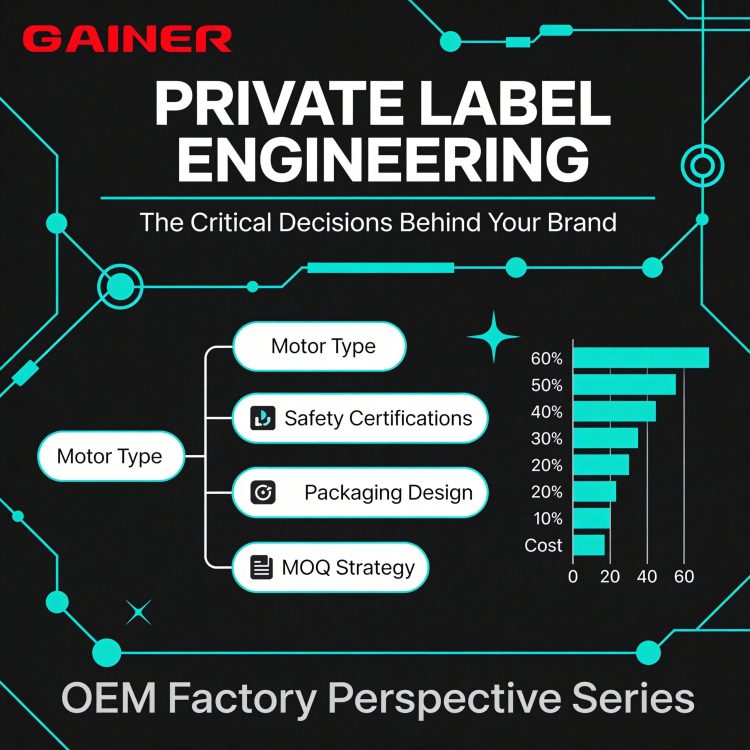
Private Label Kitchen Appliances — The Engineering Decisions Behind Your Brand
Key Takeaways
- The global small kitchen appliances market reached USD 39.6 billion in 2025 and is projected to hit USD 70.0 billion by 2033, growing at a 5.6% CAGR (Grand View Research). Private-label brands are capturing an increasing share as retailers expand own-brand portfolios.
- Five engineering decisions — motor winding material, blade steel grade, housing material, attachment interface design, and packaging structure — directly determine your product’s return rate, warranty cost, and shelf appeal. A factory maintaining a defect rate below 1% across 250,000 monthly units demonstrates that these are not theoretical concerns (Gainer).
- Copper motor windings extend motor lifespan by approximately 2x compared to aluminum, but aluminum reduces conductor material cost to roughly 20% of the copper equivalent. The savings on the BOM can be erased by a single warranty claim (BestMixerGrinder).
- GS certification alone requires 8–16 weeks and annual factory re-inspection by an accredited body such as TÜV Rheinland or Intertek (ApexDura). Multi-market certification can extend project timelines by 4–8 weeks.
Introduction
When an importer says “I want to launch a private-label hand blender,” most imagine selecting a color, uploading a logo, and placing an order. The reality, drawn from 13 years of OEM/ODM manufacturing in a 9,000-square-meter facility with 6 production lines, is that private label is a sequence of irreversible engineering decisions — each carrying a direct line to your return rate and margin (Gainer).
The global kitchen appliances market was valued at USD 268.4 billion in 2025 and is forecast to reach USD 454.14 billion by 2035 (Vantage Market Research). Within this, private-label penetration continues to rise. A Grand View Research analysis of the European small kitchen appliances market — worth USD 9.06 billion in 2025 and growing at 4.7% CAGR — identifies private-label expansion as a structural driver reshaping competitive dynamics (Grand View Research).
This article walks through the five engineering decisions that define every private-label kitchen appliance project — from a custom hand blender to a full-range white label kitchen appliances program — explains the business consequences of each, maps the timeline from inquiry to container, and exposes the most expensive mistake importers make.
The Real Cost of “Just Put My Logo on It”
The phrase “OEM” creates a dangerous illusion — that the factory has a finished product, and the brand owner’s job is cosmetic. But in kitchen appliances, a “finished” product is a configuration of interdependent engineering choices: motor type, blade material, housing polymer, and attachment coupling. None are neutral. Every choice affects performance, every performance variable affects returns, and every return erodes the margin that made private label attractive in the first place.
Consider a corded hand blender. A factory might offer it with a pure copper motor or an aluminum-wound motor. The FOB price difference might be USD 3–5. The difference in field failure rate can be the difference between a 2% return rate and a 10% return rate. At 10,000 units, that is the difference between 200 returns and 1,000 returns — each generating return shipping, a refund, and a lost future sale.
An HQTS analysis of 40 home appliance inspection reports found that only 45% of inspected batches fully met workmanship criteria; 20% failed outright (HQTS). The failures clustered around the very engineering decisions examined below.
Decision #1: Motor Selection — The Heart That Determines Your Warranty Bill
The motor’s winding material is the single most consequential engineering decision in the product — and the most invisible to the consumer until it fails.
Two materials dominate: copper and aluminum. Copper offers approximately 60% higher electrical conductivity than aluminum by volume (BestMixerGrinder). This means lower resistance, less heat generation under load, and greater tolerance for sustained high-torque operation. A copper-wound motor tested under continuous daily use demonstrated a mean lifespan of 4.8 years, compared to 2.1 years for an aluminum-wound equivalent (AliExpress Engineering Review).
Aluminum’s advantage is purely economic: at equivalent conductivity, aluminum winding conductor material cost can be as low as 20% of the copper equivalent (Sina Finance). This is why budget-tier appliances default to aluminum.
The business consequence. The choice between copper and aluminum is a warranty strategy decision. An aluminum motor that fails at month 18 of a 24-month warranty generates a full replacement cost, shipping, and a lost customer. Saving USD 2–3 on the motor BOM triggers USD 15–25 in warranty fulfillment per failure. Furthermore, aluminum motors generate more heat, triggering overload protection (OLP) cutoffs more frequently — manifesting as a product that “keeps stopping,” one of the most common consumer complaints in e-commerce reviews.
At Gainer, hand blenders ship with pure copper motor windings as standard. The factory’s below-1% defect rate across 250,000 units per month reflects this philosophy: the motor is not a cost center — it determines whether your brand earns a second purchase (Gainer).
Decision #2: Blade Steel — The Edge That Defines Performance
Two stainless steel grades dominate kitchen appliance blades: 304 and 420. They belong to different metallurgical families and solve different problems (Tiscoco).
304 stainless steel is austenitic, offering superior corrosion resistance and reliable food-contact safety. It resists rust from acidic foods and survives repeated dishwasher cycles. Its limitation is hardness: 304 cannot be hardened through heat treatment, so edge retention in high-abrasion applications is inherently limited.
420 stainless steel is martensitic, heat-treatable to HRC 50–55, delivering superior edge retention and wear resistance for cutting through frozen ingredients and hard vegetables. The trade-off is reduced corrosion resistance — 420 is more susceptible to staining in acidic environments.
The business consequence. A blade that dulls after six months generates a fundamentally different customer experience than one that holds its edge for three years. The former generates returns; the latter generates repeat purchases. Importers targeting the European market face an additional dimension: LFGB certification requires organoleptic testing — verifying no taste, odor, or color transfers from the blade to food (Alibaba Seller Blog). The steel grade and finishing process must be chosen with the target market’s food-contact regulations in view from the start.
Decision #3: Housing Material — Perception Meets Thermal Reality
The housing protects the motor, dissipates heat, and communicates quality tier at the point of sale. Three material families compete:
- ABS plastic: Lightweight, impact-resistant, inexpensive. Dominant for entry-level and mid-tier appliances. Softens at approximately 105°C.
- Polypropylene (PP) : Higher heat resistance than ABS, lower cost. Often used for accessory components rather than main housings.
- Stainless steel: Premium perception, excellent heat dissipation, near-indestructible. Adds 15–30% to unit shipping weight.
The business consequence. Housing material is a brand-positioning decision disguised as an engineering choice. A product competing at €29–39 retail must use ABS or PP. A product at €69–89 in specialty retail must use stainless steel or a steel-plastic hybrid to justify the premium. The thermal performance of the housing also affects motor lifespan — a housing that traps heat accelerates winding insulation degradation. Premium manufacturers pair high-performance motors with housings designed for active heat dissipation.
Decision #4: Attachment Interfaces — The Connection That Customers Break
Hand blenders are modular: a motor unit connects to a blending shaft, whisk, and chopper bowl. Each connection point is a potential failure point. Interfaces fall into three types: bayonet mount (twist-lock) , the most common for blending shafts; press-fit (friction) coupling for simpler attachments; and mechanical latch with spring-loaded buttons.
The engineering challenge is tolerance control. A bayonet mount that is too loose wobbles during operation, generating noise and accelerated wear. A press-fit shaft with a deviation of 0.1mm can mean the difference between a secure fit and an attachment that detaches mid-use. A mechanical latch that fails to engage positively frustrates the user at every assembly.
The business consequence. Attachment interface failures are disproportionately represented in returns because they are immediately visible and intensely frustrating. A consumer whose blending shaft detaches mid-use, spraying hot soup, will not troubleshoot — they will return the product. The remedy is life-cycle testing: a factory that tests each interface through 5,000+ connect-disconnect cycles catches tolerance drift before it reaches the consumer.
Decision #5: Packaging Design — The Brand Experience That Survives Shipping
Packaging must protect the product through 40–60 days of ocean freight, communicate brand quality on a retail shelf, and meet destination-market labeling requirements. A BillerudKorsnäs analysis found that packaging is frequently under-specified because OEMs treat it as an afterthought (BillerudKorsnäs).
The business consequence. Packaging-related damage is one of the most preventable causes of returns. Packaging design must start before the final product sample is approved, because carton dimensions determine pallet efficiency and container utilization. A design that adds 2 cm to carton height may reduce container load by 8–12%, increasing per-unit shipping cost correspondingly. For retail-ready packaging, the design must also accommodate multilingual labeling, barcode placement, and market-specific certification marks — the packaging is a compliance document in physical form.
The Certification Document Trap
No private-label project fails because the product does not work. Projects fail because the certification documents are not ready when the container arrives at port.
A hand blender destined for the EU requires CE marking as a legal minimum. For the German market, GS certification — issued by TÜV Rheinland, TÜV SÜD, or Intertek — is a de facto commercial requirement. “CE is the legal floor; GS is the commercial ceiling” (ApexDura).
GS certification takes 8–16 weeks from application to issuance, including physical sample testing and at least one annual on-site factory inspection. It requires assembly drawings, electrical schematics, a bill of materials, a German-language manual, and a CB certificate if available (ApexDura).
For the US market, FDA compliance under 21 CFR costs USD 500–1,500 per material type and takes 5–10 business days. For Germany and premium EU markets, LFGB certification costs USD 800–2,000 per material type and adds organoleptic testing not required under FDA (Alibaba Seller Blog).
A product targeting multi-market distribution may require 6–8 separate certifications, costing USD 8,000–25,000 and extending the project by 4–8 weeks. Importers who treat certification as a post-production step discover this cost after the purchase order is already placed.
From Inquiry to Shipment: The Project Timeline
A private-label project with an experienced OEM partner follows six phases:
Inquiry and Specification (Weeks 1–2) : Define the product brief — target retail price, features, market, certification requirements. The factory provides a technical proposal and preliminary quotation.
Sample Evaluation and Customization (Weeks 3–6) : Evaluate existing samples. For customization — logo, color, packaging, attachments — an R&D team of 10 engineers can deliver tailored samples within 30 days (Gainer).
Certification (Weeks 3–16, parallel) : Submit samples to certification bodies. GS certification alone requires 8–16 weeks. This runs in parallel with mold development.
Mold Development and Tooling (Weeks 4–8) : Custom housing, new attachment interfaces, or proprietary packaging inserts require 4–8 weeks for injection mold development.
Production and QC (Weeks 8–14) : Full production with in-line QC and pre-shipment inspection. A factory with 250,000 units monthly capacity can produce 5,000–10,000 units within 2–3 weeks after tooling validation.
Shipment (Weeks 14–16) : FOB shipment, with ocean freight of 25–40 days to Europe or 15–25 days to the Middle East.
Total timeline: 16–20 weeks. Expedited production using backup lines can compress to 12–14 weeks (Gainer).
Common Pitfalls: “I Want the Same as Brand X”
The most common request in private-label kitchen appliances is also the most dangerous: “I want a product that is the same as [established brand], but with my logo.” This fails for three reasons.
First, intellectual property. Established brands protect their designs through utility patents, design patents, and trade dress. A factory that copies a patented attachment interface, housing shape, or control layout exposes the importer to customs seizure and legal liability. Reputable OEM partners with their own design patent portfolios will not risk their certification status by producing infringing products.
Second, specification impossibility. “The same as Brand X” is not a specification — it is a feeling. Brand X’s hand blender achieves its performance through a specific combination of motor winding specifications, gear ratios, blade geometry, and housing acoustics. Without the original engineering documentation, a factory cannot replicate this combination. What the factory can do is match the performance specification: the same wattage, RPM range, noise ceiling, and material grades. This requires a technical conversation, not a reference product.
Third, cost structure mismatch. Brand X’s product sells for EUR 89 at retail. Its BOM, amortized tooling, and per-unit margin are built around that price. A private-label product targeting EUR 39 at retail cannot use the same materials, motor, or surface finishes. The importer who asks for “Brand X quality at private-label pricing” is asking for a product that violates the laws of economics.
The constructive alternative: define the product by its performance requirements, not its resemblance to a competitor. Specify motor power, blade material, speed settings, noise level, and housing material. Let the factory propose the engineering solution that hits those targets within the cost envelope. This approach respects intellectual property, produces a verifiable specification, and aligns engineering with the retail price point.
Conclusion
Private-label kitchen appliances are not a marketing exercise with a manufacturing component — they are a manufacturing exercise with marketing consequences. The five engineering decisions described above determine whether your product generates a 2% return rate or a 12% return rate, whether your customer service inbox is manageable or flooded, and whether your brand builds equity or burns through it one defective unit at a time.
The global small kitchen appliances market is projected to reach USD 70.0 billion by 2033 (Grand View Research), and private-label penetration is accelerating. The importers who win will not be those who find the lowest FOB price — they will be those who understand that every engineering decision is a business decision, and choose a manufacturing partner whose defect rate, certification portfolio, and engineering capability match the brand promise they are making to their customers.
A factory with 13 years of OEM/ODM experience, 6 production lines, a 9,000m² facility, 250,000 units monthly capacity, and 13 international certifications — including BSCI, ISO-9001, GS, CE, CB, ROHS, REACH, LFGB, and FDA — is not just a supplier. It is the engineering foundation on which a private-label brand is built or broken. For importers sourcing from a kitchen appliance OEM China partner, the difference between a transactional supplier and an engineering-driven OEM kitchen appliance manufacturer is the difference between managing returns and building a brand (Gainer).
Related Engineering Resources
- Amazon Kitchen Appliance Seller’s Sourcing Guide — How to Source Hand Blenders from Chinese OEM Factories for Amazon FBA — Amazon FBA sourcing guide for hand blenders from Chinese OEM factories
- MOQ in Kitchen Appliance Manufacturing — What 1,000 Pieces Really Means — What 1,000-piece MOQ really means in kitchen appliance manufacturing
- Private Label Hand Blenders for Amazon FBA: The Real Cost Breakdown from a Shenzhen Factory Floor — Real FBA cost breakdown from a Shenzhen factory floor for private label hand blenders
- How to Choose a Chinese Small Appliance OEM Factory: The 5-Step Verification Method — 5-step verification method to choose a reliable Chinese small appliance OEM factory