MOQ in Kitchen Appliance Manufacturing — What 1,000 Pieces Really Means
Key Takeaways
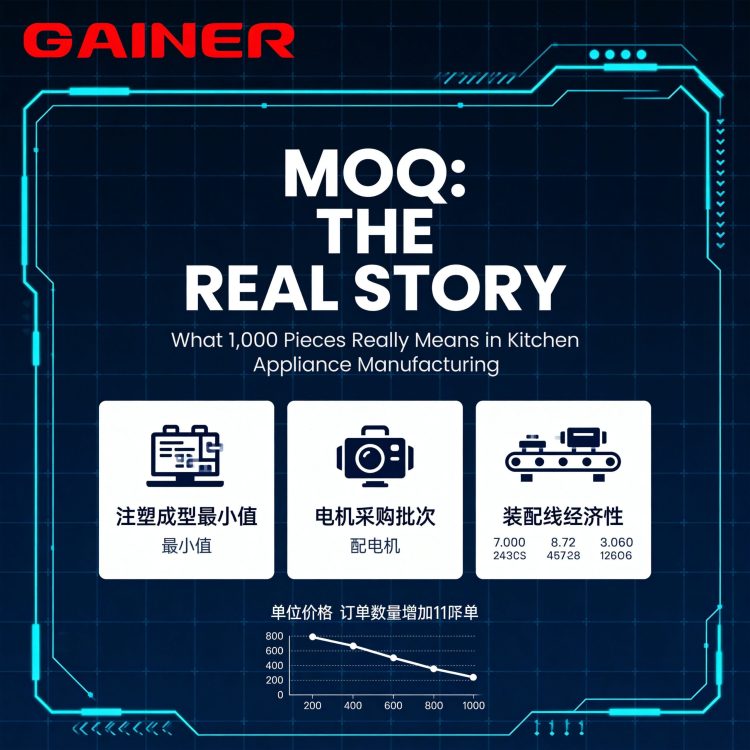
- A hand blender MOQ of 1,000–3,000 units is not a sales tactic — it is the exact intersection of four independent engineering constraints: injection mold amortization, motor supplier minimums, PCB SMT batch economics, and packaging printing setup costs.
- The 30% unit price reduction between 1,000 and 5,000 units comes from three distinct mechanisms — mold amortization (up to 5× difference per unit), raw material purchasing tiers (15–25% cost difference), and production line changeover cost absorption — not generic “economies of scale.”
- A meat grinder carries a fundamentally higher MOQ than a hand blender because die-cast metal parts and gearbox assemblies add supplier layers, each with its own minimum batch constraint.
- The most effective way to reduce MOQ is not to ask for a lower price — it is to reduce customization scope. Accepting the factory’s standard color with your logo only can cut MOQ by 30–40%, because it eliminates the color-change setup cost on the injection molding line.
A factory quotes 1,000 pieces for a hand blender, and the buyer — who wanted to test the market with 200 units — thinks the factory is being difficult. The factory is not being difficult. The factory is doing arithmetic.
This article explains that arithmetic from the engineering floor up: the four hard constraints that set the MOQ floor, why different product types have different thresholds, what changes in the cost structure between 1,000 and 5,000 units, the real options below MOQ, and how to engineer your specifications to make the MOQ work for you.
The Four Engineering Constraints That Set the 1,000–3,000 MOQ Floor
A kitchen appliance factory’s MOQ is the highest number among four independent minimums, not a number chosen by a sales manager. Each constraint comes from a different supplier in the chain, and none of them care about your market-testing budget.
Injection Mold Amortization — The Dominant Constraint
A hand blender typically requires three to five injection molds: the main housing (two halves), the blade guard, the button panel, and accessory parts like the blending cup.
A production-grade mold for a hand blender housing, cut from 718H steel (HRC 33–38, life expectancy 500,000–800,000 shots), costs approximately $8,000–$15,000 per cavity (ZetarMold). A full set of three to five molds can reach $30,000–$60,000 in tooling investment. Lower-grade P20 steel (HRC 28–32, ~300,000–500,000 shots) reduces this to $6,000–$10,000 per mold, with shorter service life (维亚达科技).
Now consider the amortization. A $30,000 mold set spread across 1,000 units adds $30 per unit in tooling cost. The same mold set spread across 50,000 units adds $0.60 per unit. That is a 50× difference — and it is the single largest reason the MOQ exists at all. The factory cannot quote you a $8 hand blender if $30 of that is just paying back the mold. They need enough volume to bring the per-unit tooling cost below a threshold where the total price is marketable.
There is also a less visible cost: every mold startup requires a 45–90 minute cold-start procedure — barrel purging, temperature stabilization, and 15–20 scrap shots before dimensional stability is achieved. The wasted material and machine time costs approximately ¥180 (~$25) in material alone, plus 1.5 hours of machine time at $50–$150/hour (维亚达科技) (Ulitemech). This fixed cost is identical whether the run that follows produces 500 units or 5,000 — but in the 500-unit case, it represents a much larger share of the total.
Motor Minimum Order Quantity — The Hardest Floor
The universal AC motor inside a hand blender — typically a series-wound universal motor rated at 200–1,000W — is not built by the appliance factory. It comes from a specialized motor manufacturer. And those manufacturers have their own MOQ.
Across multiple factory listings on major B2B platforms, the standard MOQ for a universal motor used in hand blenders, food processors, and mixers is 1,000 pieces (Fengheng Micromotor). Some suppliers offer 500-piece minimums for standard catalog motors, and a few accept 100-piece orders — but at a substantial per-unit premium. A hand blender motor costs approximately $1.50–$4.00 at 1,000 pieces, depending on power rating and copper content.
Why 1,000? The stator and rotor lamination tooling (steel stamping dies for the motor’s magnetic core) costs $3,000–$8,000 to produce. The winding setup — configuring the coil-winding machine for a specific turn count, wire gauge, and pattern — takes 2–4 hours of technician time. Below 1,000 units, the per-unit setup cost makes the motor unprofitable. The appliance factory cannot change this.
PCB SMT Minimum Batch — The Hidden Multiplier
Every hand blender with variable speed control, a pulse function, or an LED indicator has a printed circuit board assembly (PCBA) inside. This board is manufactured through surface-mount technology (SMT) — automated pick-and-place machines that populate components onto the board at high speed. SMT has its own brutal batch economics.
A PCB assembly order carries fixed setup costs: the stencil costs $8–$16, engineering file preparation and machine programming costs $8–$25, and the NRE (non-recurring engineering) fee can run $500–$3,000 (JLCPCB) (电子发烧友). These are one-time costs amortized across the entire order.
For a 100-piece PCB order, setup alone adds $5–$30 per board. At 1,000 pieces, it drops to $0.50–$3 per board. The SMT assembly cost per solder joint also drops — from $0.03–$0.06 at small volumes to $0.01–$0.03 at mass production (IWDF Solutions). A hand blender control board with 50–80 solder joints costs approximately $3–$6 to assemble at 1,000 units, versus $8–$15 at 100 units.
The practical minimum batch for cost-effective PCB assembly is 500–1,000 units, and the appliance factory’s MOQ must respect this floor.
Printing and Packaging Minimum Setup
The final constraint is the one most buyers overlook: the color box. The retail packaging for a kitchen appliance — a four-color offset-printed cardboard box — requires a printing plate for each color. A set of four CMYK plates costs $200–$500, a fixed cost regardless of whether you print 100 boxes or 10,000 (Alibaba packaging suppliers).
The practical minimum for custom color boxes is 500–1,000 pieces — below that, plate cost per box is unreasonable. A standard kraft box with a sticker label can be ordered as low as 100–300 pieces, which is why simplified packaging is one of the fastest ways to reduce an effective MOQ. Accepting the factory’s standard color with your logo only can reduce MOQ by 30–40% by eliminating the color-change setup cost (APEXDURA).
MOQ by Product Type: Why a Meat Grinder Is Not a Hand Blender
The four constraints above apply to all kitchen appliances, but their severity varies dramatically by product category. Understanding these differences is essential for setting realistic sourcing expectations.
Hand blenders sit at the low end, typically 300–1,000 units for existing-tooling models from Tier 1 factories in Zhongshan and Ningbo (APEXDURA). A hand blender has approximately 15–25 components: a motor, a PCB, two to four injection-molded housing parts, a stainless steel blending shaft, a blade assembly, a switch, and a power cord. The relative simplicity means fewer suppliers, fewer MOQ constraints, and a lower threshold.
Meat grinders are a different category. A meat grinder requires 30–50+ components, including several die-cast aluminum or zinc alloy parts — the grinding head housing, auger, cutting blade carrier, and die plate. Die-casting molds cost 30–50% more than injection molds of equivalent size, and die-casting minimum runs are typically 2,000–5,000 pieces due to higher setup costs and material waste. The gearbox assembly adds another supplier layer with its own MOQ. The result: a typical MOQ of 1,000–3,000 units — roughly double that of a hand blender.
Stand mixers occupy the highest tier, with OEM MOQs typically 2,000–5,000+ units. A stand mixer has 50–80+ components including a planetary gearbox (precision-machined gear set requiring CNC cutting and heat treatment), multiple large injection-molded housing parts, a stainless steel bowl, and multiple attachments. Each major component group — gearbox, motor, housing, bowl, attachments — comes from a different supplier with its own MOQ. The gearbox alone, with its worm gear and ring gear, typically carries a 500–1,000 set minimum batch. Cascading these supplier minimums pushes the finished product MOQ into the thousands.
The Real Math: What Changes Between 1,000 and 5,000 Units
A common assumption is that the price difference between 1,000 and 5,000 units is a simple volume discount. It is not. It is the sum of three independent cost-reduction mechanisms, each of which operates on a different curve.
Mold amortization is the steepest curve. At 1,000 units, the per-unit mold cost might be $1.20 (assuming a $6,000 mold set amortized over 5,000 units — the factory’s minimum expected lifetime volume for a new OEM product). At 5,000 units, it drops to $0.24. This fivefold reduction is the single largest contributor to the price difference, and it has nothing to do with the factory’s production efficiency — it is purely arithmetic.
Raw material purchasing is the second mechanism. ABS plastic resin — the most common housing material for kitchen appliances — shows a 15–25% price difference between 1-ton and 25-ton bulk purchases (Alibaba resin listings). For a hand blender using approximately 200g of ABS, this translates to roughly $0.05–$0.15 per unit. Modified materials — such as 30% glass-fiber-reinforced PP — carry even steeper volume premiums because they require minimum batch quantities of 200–500kg from the compounder (维亚达科技).
Production line changeover is the third mechanism. Setting up an assembly line for a new SKU — loading components, calibrating torque drivers, running the first 50 units through QC — costs approximately 4–8 hours of line time (APEXDURA). At a factory running 12-hour shifts, this represents roughly $200–$600 in fixed cost. Spread across 1,000 units, that is $0.20–$0.60 per unit. Spread across 5,000 units, it drops to $0.04–$0.12 per unit.
The composite effect is significant. Real factory pricing from a 9-year Alibaba supplier shows a hand blender at $8.00 (1,000–1,999 pcs), $6.40 (2,000–4,999 pcs), and $5.60 (5,000+ pcs) — a 30% reduction (Cixi Lotek). Notably, a premium hand blender set with stainless steel housing shows only a 3–4% reduction across the same range, because component cost (motor and stainless steel) dominates over setup cost at every volume (Alibaba listing).
What Happens When You Order Below MOQ — The Real Options
When a buyer cannot meet the stated MOQ, there are four real mechanisms — each with genuine trade-offs.
Stock and surplus inventory is the simplest route. Factories frequently carry surplus from previous production runs — overrun from large retail orders, trade show samples, or end-of-season stock — available in quantities as low as 50–500 units at prices below custom production cost (NewBuyingAgent). The limitation is severe: stock products cannot be customized — color, branding, and packaging are fixed. For market testing, this is the cheapest and fastest route. For brand building, it is useless.
Order consolidation — combining multiple small buyers’ orders into a single production run — is the traditional model used by trading companies for decades. The agent coordinates production, manages minor spec variations (same product, different colors or packaging), and splits the output (NewBuyingAgent). This works well for standard products with limited customization. It breaks down for buyer-specific OEM where each spec variation requires a separate run — because an injection molding color change alone takes 1–2 hours and generates material waste.
Shared molds and open mold libraries are increasingly common in manufacturing clusters, where public mold utilization rates exceed 60% and sample turnaround can be compressed to 72 hours (1688 Wiki). A factory maintains a library of molds that any client can use without paying the mold fee. The trade-off: the product shape is fixed — you differentiate through branding, packaging, and color, not industrial design. For a startup, this is often the optimal entry point: validate the market with a proven form factor, then invest in custom tooling once volume justifies it.
Tiered pricing — accepting a higher per-unit price for a lower MOQ — is the most straightforward and expensive option. Per-unit prices for sub-MOQ orders can be 30–80% above the standard wholesale rate (NewBuyingAgent). A Tier 1 factory quoting $8.00 at 1,000 units for a hand blender might accept 200 units at $9.00–$9.60 — an 8–12% premium that compensates for higher per-unit fixed costs (APEXDURA). About 40% of Tier 1 factories accept this for a first order, especially with a written commitment for a follow-up order of 2× the first quantity.
How to Engineer Your MOQ — Not Just Negotiate It
The most effective MOQ reduction strategy is not a negotiation tactic. It is a specification decision. The following five approaches are listed in order of impact, from highest to lowest.
1. Reduce customization scope on the first order. Accepting the factory’s standard color with your logo only — rather than a custom Pantone-matched color — can reduce MOQ by 30–40% because it eliminates the injection molding color-change setup cost (APEXDURA). Similarly, standard packaging (kraft box with sticker) instead of a custom four-color box eliminates the printing plate setup cost and allows orders as low as 100–300 pieces.
2. Combine SKUs at the container level. If you want 300 units each of two models, most factories accept 300 + 300 = 600 units as meeting a 500-unit MOQ, because the combined order fills the same production slot. Negotiate at the container level, not per SKU (APEXDURA).
3. Time your order for off-peak production. Kitchen appliance factories run at 85–95% capacity from July–October (Q4 retail build-up). January–April is 60–70% capacity. During this off-peak window, MOQ flexibility increases by 20–30% (APEXDURA). A January order for 700 units might receive the same acceptance as a September order for 1,000 units.
4. Accept a higher unit price for lower MOQ. Accepting a unit price 8–12% above the standard quote unlocks 50% of the stated MOQ at most Tier 1 factories. The factory calculates MOQ based on margin, and a higher unit price compensates for reduced volume (APEXDURA).
5. Provide a written commitment for a follow-up order. A signed letter of intent for a second order of 2× the first quantity — conditional on quality approval — gives the factory a projected revenue horizon that justifies absorbing setup costs across two production runs instead of one (APEXDURA).
Conclusion
The MOQ in kitchen appliance manufacturing is not a policy. It is a physics problem — the sum of four independent engineering constraints, each with a hard floor driven by tooling, material, and labor costs that no negotiation can eliminate.
The question buyers should ask is not “Can I get a lower MOQ?” It is “Which specification decisions am I making that are driving the MOQ higher than it needs to be?” In most cases, the answer is: the custom color, the full-color packaging, and the single-SKU order. Remove those three variables, and the MOQ can drop from 1,000 to 300–500 units — not because the factory changed its policy, but because the engineering constraints changed.
The MOQ is a design problem. Solve it at the specification stage, not the negotiation table.
This analysis is based on factory-direct sourcing data, B2B platform pricing, and manufacturing process economics from the kitchen appliance production clusters in Guangdong and Zhejiang. All cited prices and MOQ figures are from publicly available factory listings and industry publications as of 2026.
Related Engineering Resources
- Amazon Kitchen Appliance Seller’s Sourcing Guide — How to Source Hand Blenders from Chinese OEM Factories for Amazon FBA — Amazon FBA sourcing guide for hand blenders from Chinese OEM factories
- Private Label Kitchen Appliances — The Engineering Decisions Behind Your Brand — The engineering decisions behind your private label kitchen appliance brand
- Private Label Hand Blenders for Amazon FBA: The Real Cost Breakdown from a Shenzhen Factory Floor — Real FBA cost breakdown from a Shenzhen factory floor for private label hand blenders
- How to Choose a Chinese Small Appliance OEM Factory: The 5-Step Verification Method — 5-step verification method to choose a reliable Chinese small appliance OEM factory